
A local guide to Amsterdam in autumn, with seasonal tips, and rainy-day ideas.
Written by Alexandra, Founder of Who Is Amsterdam
Amsterdam has a particular talent for looking good in bad weather.
Summer gets most of the attention. Long evenings. Terraces. Boats everywhere. Everybody suddenly owns sunglasses.
Then September arrives and the city starts changing its mind.
Every season has its own charm here. But honestly? This city is made for autumn and winter.
Why? Because it’s super compact and full of cosy cafés. You walk a little, then you warm up in a café. You walk a little, then you pop into a museum. You walk a little more, then you eat something good. Even on a cold, rainy day, Amsterdam just works.
Amsterdam’s official autumn guide makes a similar case for the season: the city has more than 400,000 trees, which means the parks and canal streets visibly change colour as autumn develops, while the cultural calendar moves into one of its busiest periods.
The weather will participate.
It may not cooperate.
Those are different things.
1. Why Autumn Suits Amsterdam
People often ask about the best season for Amsterdam as though there is one correct answer.
I do not think there is.
Spring brings tulips and longer days. Summer makes the parks and canals feel social until late. Winter has lights, dark cafés and excellent excuses to stay indoors.
Autumn sits somewhere between all three.
September can still feel soft, while Amsterdam in October usually looks and feels properly autumnal: changing leaves, shorter days and walks increasingly planned around coffee stops. November is darker and moodier, and I mean that positively.
The main thing to understand about Amsterdam autumn weather is that it is unpredictable.
Do not plan your trip to Amsterdam around a fantasy week of crisp blue skies. Bring layers, pack a waterproof jacket and check the forecast in the morning. KNMI’s climate normals are useful if you want the data; for your suitcase, the translation is simple: prepare for change.
That does not mean filling your itinerary with indoor reservations.
Some of Amsterdam’s best autumn hours happen just after the rain, when the canals turn darker, the streets reflect the light and the city suddenly looks better than it did half an hour earlier.
If the forecast becomes properly wet, our guide to what to do in Amsterdam when it rains covers museums, cinemas, brown cafés and other places worth retreating to.
Rain changes the rhythm of Amsterdam more often than it ruins it.
In our opinion, here’s what you should be doing in Amsterdam in Autumn:
2. Take the Canal Walks Slowly
There is a specific moment in autumn when the canal belt starts looking slightly unreasonable. Yellow leaves collect against the edges of the water. Trees throw colour over the dark brick houses. A brief shower passes and every lamp, window and bicycle light starts reflecting off the street.
And then there are the trees. The canal belt is full of them, and when they change colour, they match the houses: browns, reds and yellows, all in the same palette. It’s just gorgeous.
You take one photograph.
Then another.
Then you realise you have spent twelve minutes photographing the same bridge.
This is acceptable.
Brouwersgracht Into the Jordaan
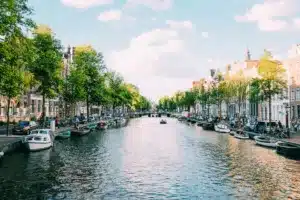
For one of my favourite Amsterdam autumn walks, I would start around Brouwersgracht and move towards the western canal belt.
Brouwersgracht is broad enough to give you those long water views, but it still feels connected to neighbourhood life. From there, turn onto Prinsengracht and drift into the Jordaan through streets around Noordermarkt, Egelantiersgracht and Bloemgracht.
Do not rush towards a finish point.
Autumn suits this part of Amsterdam because there are so many places to stop when the weather changes.
A café. A small shop. A market if you are there on the right day. Another café because the first one established a precedent.
Our guide to Amsterdam’s most beautiful canal walks has longer routes through Brouwersgracht, the Jordaan and the main canal belt if you want to build a full morning around walking.
The best photo spots in Amsterdam guide are useful here too. Autumn changes when the canals are photographed best because lower light, wet streets and changing leaves can make the familiar spots look completely different from their summer versions.
Plantage When You Want More Trees
If the canal belt gives you autumn reflected in water, Plantage gives you more space to notice the season itself. This is one of the parts of Amsterdam I like when the centre starts feeling busy.
Walk around Nieuwe Herengracht, continue towards Hortus Botanicus and take your time around Plantage Middenlaan. You are still close to the old centre, but the streets feel greener and calmer.

Hortus Botanicus is especially useful on one of those autumn days when the weather cannot commit to being indoors or outdoors. The garden dates to 1638 and now contains thousands of plant species, with outdoor gardens and greenhouses that let you change the climate without changing the neighbourhood.
This is also where an autumn walk can become a rainy-day plan without anybody needing to call a meeting about it.
Walk until the shower becomes annoying.
Go inside.
Come back out when Amsterdam has finished.
Vondelpark for the Obvious Reason
Vondelpark is obvious. Go anyway.
There is a strange habit in travel writing of treating famous places as though popularity automatically damaged them.
Sometimes a park is popular because it is a good park.
Vondelpark opened in the nineteenth century and remains Amsterdam’s best-known central green space. In autumn, its mix of paths, ponds and mature trees gives you more leaf colour in one walk than most canal routes.
Go in the morning if you want it quieter. Walk without trying to cover the whole park.
Leave through the Oud-West side and find somewhere warm.
3. Learn the Difference Between a Cosy Café and a Brown Café
Autumn makes Amsterdam’s cafés considerably more persuasive.
In July, sitting inside can feel like a small failure of ambition. In October, you walk past a steamed-up window, see candles on a wooden table and reconsider every plan you made that morning.
This is where “cosy” becomes useful, although the Dutch have their own word for the broader feeling: gezellig.
There’s no one-to-one translation. The closest English word is cosy, but gezellig is more than that: it’s being connected with other people in a warm, cosy atmosphere. And because Amsterdam is so compact and full of these places, it’s often called a gezellig city.
A modern neighbourhood café can be gezellig. So can someone’s kitchen. But the traditional bruin café has its own thing going on.
Why Brown Cafés Feel Made for Autumn
The brown cafés in Amsterdam are old-fashioned café-bars known for dark wooden interiors, low lighting and the accumulated feeling that several generations have already spent longer than planned inside.
The “brown” refers to the dark interior traditionally associated with wood, age and decades of smoke. Smoking indoors has changed. The aesthetic survived.
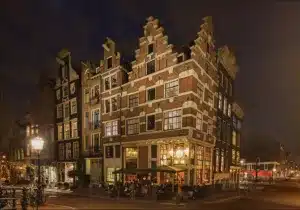
Café Papeneiland is an easy example.
It sits where Brouwersgracht meets Prinsengracht, in a building dating to the seventeenth century. Inside, it is dark wood, old details and the kind of room where an autumn afternoon can disappear without making much noise.
A little farther into the Jordaan, Café ’t Smalle has another version of the same feeling. The site was connected to a distillery around 1780, and the modern café still has wood panelling, old barrels and a canalside location on Egelantiersgracht. The official city guide to Café ’t Smalle gives the history if you want more than the drink.
Then there is Café Chris, also in Jordaan. Its history reaches back to 1624 and is connected to the workers building nearby Westerkerk.
You do not need to visit all three.
Please do not turn brown cafés into another attraction checklist.
Pick one.
Sit down.
Order a beer, jenever, coffee or something warm.
If it starts raining outside, congratulations. The room has improved.
For a broader evening after the light disappears, our Amsterdam nightlife neighbourhood guide explains where to go depending on whether you want brown cafés, live music, neighbourhood bars or a considerably later night than this article is proposing.
And Sometimes You Want Coffee, Not History
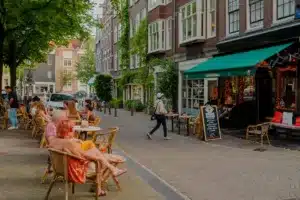
Not every wet afternoon needs to become a heritage drinking experience.
There are cosy cafés in Amsterdam all over the city where the important qualities are coffee, warmth and being allowed to sit for a while.
I would choose by neighbourhood rather than make a cross-city journey towards a café somebody described as “the cosiest in Amsterdam.”
If you are in Jordaan, stay there.
If you are in De Pijp, find somewhere around the neighbourhood rather than taking a tram north because an algorithm told you a cinnamon bun elsewhere has achieved greatness.
Oud-West works particularly well for this kind of afternoon because cafés, shops, Foodhallen and cultural spaces sit close together. De Pijp gives you the same flexibility around Albert Cuyp Market and the streets beyond it.
The principle matters more than the address. Autumn is better when the café fits into the walk. Not when the entire day is organised around reaching the café.
4. Let the Rain Choose Part of the Day
There are two types of people visiting Amsterdam in autumn.
- The first checks the forecast and becomes distressed by a rain icon.
- The second has been to the Netherlands before.
An Amsterdam rainy day does not necessarily mean eight continuous hours of rain. It can mean grey morning, shower, dry hour, another shower, blue patch, wind, rain again and a final burst of sunshine at the exact moment you have already entered a museum.
Planning needs some flexibility.
I would choose one neighbourhood and give myself indoor places nearby.
In the Jordaan, that might mean a canal walk, Noordermarkt if it is running, lunch, a brown café and one of the smaller museums around the centre.
Around Museumplein, it is even easier. Book the museum you genuinely want to see, then leave space around it for Vondelpark, coffee or a walk through Oud-Zuid when the weather improves.
In Plantage, pair the neighbourhood with Hortus.
In Noord, take the ferry and use EYE or STRAAT as the indoor anchor.
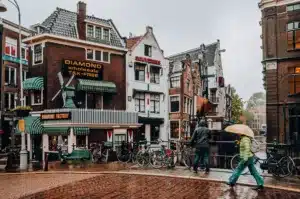
Our full rainy-day Amsterdam guide covers those options in much more detail, including Rijksmuseum, STRAAT, EYE and the cinemas worth hiding in.
What I would not do is book three museums because the weather forecast looked wet five days earlier.
You arrive.
It is dry.
Now you are indoors until 17:00 because Wednesday-you panicked.
If the rain is light, walk through it. A proper waterproof jacket is more useful than building your whole trip around avoiding moisture.
And if the weather becomes miserable?
Go inside.
There is no prize for suffering beautifully beside a canal.
5. Pick Neighbourhoods That Work at Autumn Speed
The best things to do in Amsterdam in autumn are often just normal Amsterdam activities at a slower pace.
Walk the Jordaan, stop for coffee and eat something along the way. Our Self-Guided Food Tour de Jordaan works well because you can follow the six food stops at your own speed.
De Pijp is another easy choice: Albert Cuyp Market for browsing, Sarphatipark for a walk and plenty of cafés if the weather turns. Our guide to the best food markets in Amsterdam covers more options around the city.
For something quieter, try Oost or take the free ferry to Noord. Dappermarkt, Oosterpark, Javastraat, NDSM and EYE Filmmuseum all work particularly well on an autumn day.

The basic autumn rule is simple: choose a neighbourhood and stay long enough for it to become a place rather than another stop.
How I’d Spend One Proper Autumn Day in Amsterdam
If I had one day of autumn in Amsterdam, I would not begin with a 08:00 reservation. Autumn mornings are allowed to start like mornings.
Have coffee.
Look outside.
Check whether the rain has decided anything.
Then go.
Amsterdam lends itself beautifully to a slow autumn day like this:
- Have breakfast
- Join a walking tour
- Warm up with a nice lunch
- Go to a museum
- Walk a little bit more
Yes, it can rain, and it can be windy, so come prepared. But honestly, it’s gorgeous.
Morning: Canals Before Lunch
I would begin around Brouwersgracht and walk into Jordaan.
If the weather is dry, take the longer route through Prinsengracht, Egelantiersgracht and Bloemgracht. If rain starts, move the café stop forward.
This is also a good morning for the Hello Amsterdam Walking Tour if it is your first day in the city. The two-hour route gives you the historic centre, canal belt and the context behind what you are looking at, which makes the slower wandering afterwards more interesting.
Autumn works well for walking tours because you are moving. Standing still in November is a different recreational activity.
Afternoon: Eat, Then Give the Weather a Vote
For lunch, I would stay in the neighbourhood or head towards a market rather than crossing Amsterdam for one famous restaurant.
If it is Saturday and Noordermarkt or Lindengracht fits the route, go there. If you want a more structured food afternoon, use the Jordaan self-guided route and take your time.
Then I would look at the sky.
Dry?
Keep walking.
Steady rain?
Pick one indoor place.
Museum, cinema, Hortus greenhouse, EYE.
One.
Not four.
That is more useful than me telling you in an evergreen article to attend an exhibition that closed seventeen months ago.
Evening: Brown Café, Then Decide
By late afternoon, I would find a brown café. Papeneiland if I am around the north Jordaan.
Somewhere else entirely if that is where the day took me.
Order something.
Sit.
Let it become evening.
Then decide if you still want dinner somewhere busy or if the day has already done enough. That is one of the things I like most about Amsterdam in fall.
Summer encourages momentum. Autumn gives you permission to stop.
A good day does not need to end with the biggest attraction, the newest restaurant or another reservation. Sometimes it ends because you are in a warm bar, your coat is drying beside you and the canal outside has gone dark.
That is plenty.
Frequently Asked Questions
Be prepared for rain, but also for warmer days. Layers are the key. Bring an outfit with a T-shirt and a sweater for days around 18 to 20°C, and something for wind and wet weather too: a really good rain jacket, spare socks (because your shoes might get wet) and, ideally, waterproof shoes. Whatever you pack, make sure your shoes are comfy. You’ll be walking a lot.
Yes, absolutely. Our walking tours, like the two-hour Hello Amsterdam Walking Tour, also run in the rain. You just need to be prepared. If there’s a proper storm, we won’t go out, but rain is simply part of this city sometimes. Bring a hat and gloves too. On a cold autumn day, they’re really handy.
Many are. Amsterdam cafés often keep terraces running well beyond summer, particularly when they have awnings, heaters or covered seating. Exactly how appealing that feels depends on the wind as much as the temperature.
For the major museums, yes. Autumn can be quieter than peak summer on some dates, but places such as the Van Gogh Museum and Anne Frank House use timed tickets and can still sell out. Book anything you would be genuinely disappointed to miss rather than assuming rain will leave you with unlimited last-minute museum options.
It exists, but it does not define Dutch autumn in the way it does in some countries. You will find themed club nights, film screenings, parties and events around the end of October, particularly in Amsterdam’s nightlife and cultural venues. The programme changes each year, so check the current city events calendar rather than planning around an old Halloween roundup.
See Amsterdam At Autumn Speed
Amsterdam is gorgeous in autumn. It’s also the perfect time to stop treating the city like a checklist. If you want some local context while you walk, explore Who Is Amsterdam’s tours and choose the one that fits the way you want to see the city. Then leave enough room in the day for rain, coffee and changing your mind.