
A local’s honest guide to the best rainy day in the city.
Written by Alexandra, Founder of Who Is Amsterdam
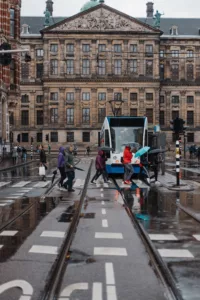
Amsterdam in the rain has a specific look.
The canals turn darker.
The cobblestones shine.
Cyclists pull their shoulders up around their ears and continue at exactly the same speed.
Knowing what to do in Amsterdam when it rains can lead you into parts of the city you might otherwise walk straight past.
A film museum across the water.
A cinema so beautiful that the film becomes almost secondary.
Or an old brown café where two hours can quietly become four.
Rain changes the pace of Amsterdam.
You should probably let it.
One thing I always tell visitors is that Amsterdammers do not really change their plans because of the weather.
We put on a rain jacket.
We cycle anyway.
We walk anyway.
We simply adapt.
That is the local approach to a rainy day here. The weather changes the rhythm of Amsterdam, but it rarely stops it.
First: don’t panic over the forecast
Dutch weather apps have a flair for drama.
A rain icon can mean six hours of committed grey misery.
It can also mean twelve minutes of rain at 10:17, followed by sunshine, wind, more rain, a suspiciously blue sky and another shower while you are trying to unlock a rental bike.
Amsterdam weather changes quickly.
So before cancelling everything, look at the hourly forecast.
There is a difference between scattered showers and the sort of rain that makes the canal boats look concerned.
For light rain, keep walking. Bring a proper jacket. Stop somewhere warm when you need to.
For steady rain, choose two or three indoor places in the same part of the city and move between them without crossing Amsterdam six times.
For a downpour, accept defeat with dignity and enter a museum.
You have options.
Quite a lot of them.
Choose a rain jacket over an umbrella
Visitors often arrive with an umbrella. Honestly, I would invest in a good waterproof rain jacket instead.
The rain itself is usually not the main problem.
The wind is.
Even a good umbrella can become useless surprisingly quickly when the wind picks up. A waterproof jacket leaves your hands free, works while walking or cycling and is exactly what most locals wear.
If you do bring an umbrella, make it a sturdy one. Amsterdam weather is not always kind to them.
Remember how walkable Amsterdam is
Amsterdam remains incredibly walkable, even when it is raining. The city centre is compact, so you rarely need to spend hours exposed to the weather.
Walk for twenty minutes. Duck into a cosy brown café. Warm up with a coffee or hot chocolate. Browse a few shops. Visit a museum.
Then continue once the shower eases.
That is honestly how many of us experience the city. Rain changes the rhythm of your day. It does not have to stop it.
Go to the Rijksmuseum, but don’t try to see everything
The Rijksmuseum is the obvious answer.
Among all the indoor things to do in Amsterdam, few can absorb an entire rainy afternoon as successfully as this enormous building full of Dutch art, ships, silver, strange historical objects and portraits of wealthy people who look as though nobody has made them laugh since 1642.
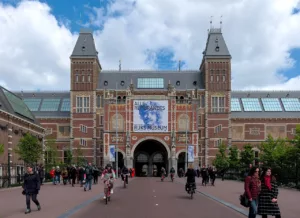
Image Source: Wikipedia
You can stand in front of Rembrandt’s The Night Watch. Find Vermeer.
Look at tiny dollhouses with more expensive furniture than most Amsterdam apartments.
But please don’t make the mistake of trying to see every room.
The Rijksmuseum is huge.
You can enter full of cultural energy and emerge four hours later unable to remember your own postcode.
Choose a handful of works. Slow down. Look properly.
If you’d rather understand why the famous paintings matter instead of nodding thoughtfully at them and hoping nobody asks for your interpretation, our private Rijksmuseum tour goes through the museum with a guide who turns art history into human stories.
The paintings become considerably more interesting once the people inside them stop feeling like distant strangers in uncomfortable collars.
Rain outside becomes irrelevant fairly quickly.
Take the ferry to EYE Filmmuseum
This requires being outside for a few minutes.
Stay with me.
Behind Centraal Station, the free ferry crosses the IJ to Amsterdam Noord.
On a grey day, the water goes steel-coloured, the city fades slightly at the edges and the enormous white EYE Filmmuseum waits on the other side looking like a spaceship that has developed an interest in European cinema.
Go inside.
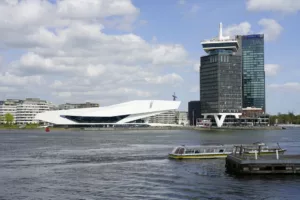
EYE has film exhibitions, screenings, permanent displays about moving images and a restaurant looking across the water toward the city.
It is one of the best Amsterdam rainy day activities because you don’t need to be a serious film person to enjoy it.
You can still walk through an exhibition, watch something strange and leave feeling unusually qualified to discuss editing over dinner.
The building itself is worth the ferry ride.
Sit by the windows for a while. Watch the rain move across the IJ. Amsterdam looks good from here when the weather has gone grey.
Possibly better.
Spend an afternoon inside STRAAT Museum
Most museums ask you not to touch anything.
STRAAT Museum feels as though the walls might have broken that rule first.
The museum sits inside an enormous former industrial space at NDSM in Amsterdam Noord, filled with huge works of street art and graffiti. Not small framed pieces with a polite little label next to them.

Image source: Wikipedia
Faces several metres high. Colour running across concrete. Pieces that make you walk backward to see the whole thing.
This is one of the strongest things to do in Amsterdam when it rains if you want art without spending another afternoon surrounded by seventeenth-century merchant portraits.
The journey there helps too.
Take the ferry from behind Centraal Station to NDSM. The ride is free. The weather may be gloomy. The IJ may be doing its moody grey performance.
Then you step into a warehouse filled with colour.
Afterward, stay around NDSM for food or a drink instead of rushing back into the centre. Rain is easier when you stop treating every fifteen minutes as travel time between attractions.
Pick a part of the city.
Stay there.
Amsterdam improves when you give it enough time to stop showing off.
Sit in a Bruin Café and Relax
A rainy afternoon is an excellent excuse to understand the bruin café.
These are Amsterdam’s old brown cafés. Dark wood. Low ceilings. Candles. Beer taps that have seen more life than most people.
The name comes from the brown interiors, darkened over decades by wood, smoke and time.

Image Source: Amsterdam.net
Visitors often enter an Amsterdam café, order one drink, finish it efficiently and leave because the next item on the itinerary is waiting.
Don’t do that.
Order something. Sit down. Watch the windows fog. Let your coat dry over the back of the chair. Have another drink or a coffee. Get bitterballen.
My own rainy-day favourites are Café Papeneiland, Café ‘t Smalle, Café de Druif and Café de Tuin.
They each give you that warm, lived-in Amsterdam feeling that is difficult to manufacture: dark wood, small tables, local conversation and absolutely no pressure to leave quickly.
Choose the one closest to the part of the city you are already exploring. The point is to settle in for a while, not cross Amsterdam in the rain for the sake of completing a list.
A rainy day in Amsterdam gives you permission to stop moving for a while.
Use it.
The city will still be outside in an hour.
Probably wetter.
Eat Around Foodhallen
Rain creates a specific group travel problem.
One person wants Dutch food.
One wants tacos.
Someone has decided they need dumplings immediately.
Another person says they aren’t hungry and will then eat half of everyone else’s food.
So, go to Foodhallen.

Image Source: Feel Local
Inside De Hallen in Oud-West, a former tram depot has become a busy indoor space with food stalls, a cinema and enough choice to end most arguments before they become international incidents.
Get separate things. Share badly. Order more.
It works particularly well when you’re searching for indoor activities Amsterdam can offer without committing to another museum.
Because there is a limit.
After several hours of paintings, historical objects and reading small labels in careful museum lighting, your brain may begin requesting fried food.
Listen to it.
De Hallen also works well as part of a wet afternoon in Oud-West. Eat, catch a film, have a drink, then wait to see whether the sky has calmed down.
Sometimes it does.
Sometimes Amsterdam has other plans.
Eat somewhere I genuinely love
Foodhallen is useful when a group wants six different things. But sometimes a rainy day calls for choosing one place, sitting down properly and staying there.
For lunch, I would go to Van Dobben. It is simple, local and exactly the sort of unfussy Amsterdam institution that works when you want something warm without turning lunch into a three-hour event.
For dinner, some of my personal favourites are De Belhamel, De Silveren Spiegel, Gitane and Cecconi’s.
They are very different from one another, which is useful. Choose the one that suits your evening, book ahead when you can and let dinner become the final indoor part of the day rather than another stop to rush through.
Walk through the greenhouses at Hortus Botanicus
Rain outside a greenhouse feels almost theatrical.
Hortus Botanicus Amsterdam sits in the Plantage neighbourhood and dates back to 1638. Parts of the garden are outdoors, so this is not a complete escape from rain, but the greenhouses make it worth considering when the weather is wet rather than apocalyptic.

Image Source: De Hortus
The Palm House alone can make a wet afternoon feel less like a backup plan and more like something you would have chosen anyway.
And once the rain slows, stay in the Plantage.
This neighbourhood is quieter than much of central Amsterdam. Wide streets. Trees. Beautiful buildings. People walking dogs with the calm confidence of people who own waterproof shoes.
It is a good place to let the city become residential again.
Watch a film inside Pathé Tuschinski
Pathé Tuschinski opened in 1921 and mixes Art Deco, Art Nouveau and Amsterdam School design into something wonderfully excessive. Rich colours.
Decorative lights. Painted walls. Staircases that make going to see a film feel far more glamorous than carrying popcorn should allow.
I genuinely think it is not only one of the most beautiful cinemas in Amsterdam, but one of the most beautiful cinemas in Europe.
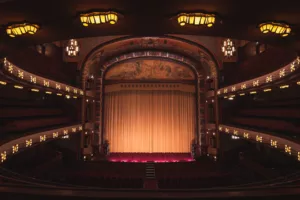
Try to book a screening in the main auditorium.
The room is magnificent.
If you are visiting as a couple, look for the Love Seats in the main auditorium or the two-seat loge and boutique options upstairs. Some include a small table and service for drinks and snacks, which turns an ordinary film into a properly memorable rainy evening.
Prices vary by film, time and package, but budgeting roughly €20-25 per person is sensible. Check the current seat map and package details when booking.
Even a mediocre film improves when you watch it under a ceiling that appears to have been designed by someone who thought restraint was a personal failure.
Among the many things to do in Amsterdam indoors, this one asks almost nothing from you.
For two hours, nobody needs you to appreciate a masterpiece, understand Dutch maritime history or make a thoughtful observation about architecture.
Culture comes in many forms.
Take a Covered Canal Cruise
Yes, a canal cruise.
Even in the rain.
Especially when you have already spent an hour walking next to canals while water arrives from both the sky and passing bicycles.
Choose a covered boat.
Sit inside.
Let someone else deal with directions.

Seeing Amsterdam in the rain from the water is different. Windows mist slightly. Canal houses reflect in wet streets. Bridges feel lower. The city becomes darker and quieter.
You also begin to understand its shape.
Amsterdam makes more sense from the canals. The narrow houses. The old warehouses. The rings of water wrapping around the centre. The constant question of how anyone moved a sofa into those buildings.
A covered cruise works best during steady rain rather than a storm. Visibility matters, and staring through a waterfall running down the window loses some charm after twenty minutes.
Check the weather.
Choose a smaller boat when possible.
Avoid treating the cruise as an emergency weather bunker.
Done well, it is part of seeing the city.
The roof is a bonus.
Try the Anne Frank House, if you planned ahead
The Anne Frank House is one of Amsterdam’s most important places to visit.
It is also one of the hardest tickets to get.
Rain will not change that.
Do not see clouds in the morning and assume you can wander over to the museum after lunch. Entry is timed and tickets are in high demand.
If visiting the Anne Frank House matters to you, plan early.

If your trip is already underway and you missed the booking window, read our guide on how to get last-minute Anne Frank House tickets.
And if tickets aren’t available, don’t spend the entire day refreshing your phone beside a canal.
Amsterdam has hundreds of years of Jewish history beyond one address. The Jewish Cultural Quarter, the National Holocaust Museum and the Portuguese Synagogue offer more context about Jewish life, persecution, survival and memory in the city.
A rainy afternoon can become a serious one.
That is okay too.
Not every travel memory needs to involve cheese.
Build a Slow Food Afternoon in the Jordaan
Rain and food work well together.
Possibly too well.
The Jordaan is full of cafés, bakeries, old pubs and small places where you can spend forty-five minutes eating something before bravely walking four minutes to eat something else.
This is a respectable system.

Our Self-Guided Food Tour De Jordaan gives you a route through the neighbourhood with stops and local context, while leaving you free to move at your own pace.
On a wet day, that matters.
You don’t need to follow somebody’s umbrella through the street while rain hits you sideways. You can pause longer. Wait for a shower. Order another coffee. Resume when the sky becomes less aggressive.
This is one of those rainy day activities Amsterdam handles naturally because the city is compact.
You walk.
You eat.
You hide somewhere warm.
You walk again.
The only danger is becoming so comfortable inside a brown café that the tour ends there.
There are worse endings.
Look beyond Amsterdam’s biggest museums
The big names get most of the attention.
Rijksmuseum. Van Gogh Museum. Anne Frank House.
All important.
But rain is a good reason to become less predictable.

The Museum of the Canals is one of the most underrated museums in Amsterdam. The exhibition is visual, easy to follow and explains how the canal belt – and much of the city around it – came into existence.
Visitors leave with a much clearer picture of why Amsterdam looks and works the way it does. It is ideal for a rainy afternoon because it gives you context you can use as soon as you step back outside.
I would also make time for Ons’ Lieve Heer op Solder – Our Lord in the Attic. You move through a seventeenth-century canal house and eventually discover a complete hidden church in the upper floors.
It is one of those museums people often remember most because the surprise is part of the experience. It feels uniquely Amsterdam and can be explored without sacrificing an entire day.
The Amsterdam Museum, Rembrandt House and Museum Van Loon are also excellent choices when you want a smaller museum with a clear story rather than another enormous collection.
Amsterdam’s smaller museums tend to be easier to understand in one visit. You can spend ninety minutes somewhere, take in the story and leave without the feeling that you failed to see seventeen important rooms.
This is useful.
Museum guilt is unnecessary.
You are on holiday.
Nobody is grading you.
And sometimes, walk in the rain anyway
Not every shower requires an indoor strategy meeting.
Amsterdam looks beautiful when wet.
The canal streets go glossy. Reflections appear everywhere. Crowds thin slightly. The city smells different.
But I often think Amsterdam is at its most beautiful just after a shower.
The cobblestones shine. The canals become giant mirrors. Reflections of the canal houses sharpen across the water, and the light can suddenly become spectacular.
That brief moment after the clouds move through is one of the reasons I would never tell visitors to write off a wet day.
Put on a waterproof coat.
Leave the umbrella behind if the wind is strong enough to turn it into modern art.
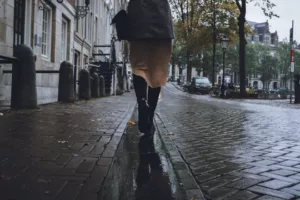
Walk through the Jordaan. Cross the smaller canals. Stop under an awning when the rain gets heavier. Have coffee. Continue.
A lot of people searching for things to do in Amsterdam when it rains are trying to avoid the weather completely.
You don’t always need to.
There is a point where trying to stay perfectly dry becomes more exhausting than accepting that part of your sleeve is now wet.
People in Amsterdam understand this.
They cycle through rain with the resigned expression of people who have had the same argument with the sky before.
You can borrow some of that attitude for a day.
A Simple Rainy-day Itinerary for Amsterdam
If you wake up to steady rain and have no plan, try this.
Start at the Rijksmuseum in the morning. Go early, choose a few galleries and resist the urge to conquer the whole building.
Have lunch at Van Dobben if you want something traditional and quick, or head toward Oud-West for Foodhallen if everyone wants something different.
In the afternoon, choose one more indoor place. Try the Museum of the Canals for the story of the city, Ons’ Lieve Heer op Solder for something completely unexpected, EYE if you like cinema or STRAAT if you want contemporary street art.
Then stop.
Do not schedule a fourth museum.
Your brain has rights.
Find one of my favourite brown cafés. Order a drink. Sit near the window. Watch bicycles move through the rain.
If the weather clears in the evening, walk.
If it doesn’t, go to Tuschinski.
This is a good day.
The forecast does not get credit.
So, what should you do when it rains in Amsterdam?
The best answer depends on the rain.
A short shower? Keep going.
Steady rain? Pick a neighbourhood and move between museums, cafés and food.
A serious downpour? Rijksmuseum. Cinema. Brown café. Accept your fate.
The city has spent centuries dealing with water.
Some of the best indoor activities Amsterdam has to offer aren’t consolation prizes.
EYE is worth crossing the IJ for in sunshine. STRAAT is worth the ferry. Tuschinski is magnificent before any film begins. A bruin café does not need a weather emergency to justify three hours of your time.
Rain changes your Amsterdam trip.
It does not have to ruin it.
Sometimes the nicest thing you can do is put on a waterproof jacket and keep walking.
The city becomes quieter. The reflections become more beautiful. You warm up in a cosy café, wait for the heaviest shower to pass and then head outside again.
That is how Amsterdam handles rain.
It adapts, carries on and usually looks even better afterwards.
Give yourself permission to do the same.
Frequently Asked Questions
Often, yes. A little rain does not automatically shut down an Amsterdam market. Stallholders are used to weather, and many have covers or awnings. If a market is one of the main reasons you are visiting a neighbourhood, check before travelling across the city for it.
Do not spend the afternoon refreshing ticket pages and becoming increasingly hostile toward your phone. Try a smaller museum instead. Amsterdam has dozens of them, including canal-house museums, photography spaces, historic homes and highly specific collections that you may never have planned to visit.
A waterproof rain jacket is usually more practical. Amsterdam can be windy, which makes umbrellas awkward or short-lived, while a jacket works whether you are walking, cycling or moving between cafés and museums. Bring a sturdy umbrella as a backup if you prefer, but do not rely on a flimsy one.
Very much so. The centre is compact, and many museums, cafés, shops and restaurants are only a short walk apart. Plan around one neighbourhood, take twenty-minute walks between stops and pause somewhere warm when a heavier shower arrives.
Yes, and this is when it becomes especially useful. Trams, buses and the metro can save you from turning a twenty-minute walk into a forty-minute argument with the weather. The important thing is to plan around stops rather than assuming every attraction is directly beside one. You may still have a short walk at either end.
Sometimes, yes. Light rain can thin out streets that are usually much busier, particularly in areas where most visitors spend their time walking outdoors.
The Jordaan, De Pijp and the canal belt can feel calmer between showers. But do not assume rain means empty streets. Amsterdam has many people with waterproof jackets and absolutely no intention of cancelling lunch.
Check directly with the venue. Some terraces have covered seating or heaters. Others may move reservations indoors when space allows. In heavier weather, outdoor bookings may be changed or cancelled. Do not assume the restaurant will automatically contact you before you leave the hotel.