
A local’s guide to where Amsterdam goes after dark.
Written by Alexandra, Founder of Who Is Amsterdam
Amsterdam is one of Europe’s great nightlife cities
Berlin tends to dominate conversations about European nightlife. It has earned that reputation, but Amsterdam deserves to be in the same conversation for very different reasons.
This city has an extraordinary relationship with music after dark.
The Netherlands has produced some of the world’s biggest DJs, including Tiësto, Armin van Buuren, Hardwell and Martin Garrix. Electronic music is not a niche interest here.
It is part of Amsterdam’s cultural identity.
Every October, Amsterdam Dance Event (ADE) turns the entire city into a meeting place for artists, promoters, labels, venues and music fans. It is the world’s largest festival and business gathering for electronic music, with events appearing in clubs, concert halls, warehouses and spaces you would never normally associate with a dance floor.
But Amsterdam nightlife is not only about electronic music. You can listen to jazz in a tiny room, watch an international artist inside a former church, spend three hours in a brown café, or sit beside a canal with friends and realise that nobody has checked the time for quite a while.
That variety is what makes going out here special. Amsterdam does not ask everyone to have the same night.
There is more than one way to spend a night out in Amsterdam
A lot of visitors arrive with a simple question: where is the nightlife area? The honest answer is that Amsterdam does not have one single nightlife district, and that is a good thing.
You might begin with dinner, walk through the canal belt and stop for a beer in a traditional brown café. From there, you could continue to a cocktail bar, listen to live jazz or blues, see a concert at Paradiso or Melkweg, and still have time to end the night in a club.
Or you might do none of that. Some of my favourite Amsterdam evenings are simply dinner, a long walk beside the canals and drinks with friends somewhere we can actually hear each other.
The best plan is to decide what kind of atmosphere you want first. Choose the music or mood, then choose the neighbourhood.
Starting with a famous square and hoping it somehow creates the perfect evening is a less reliable system.
The main Amsterdam nightlife scenes
Brown cafés: the traditional Amsterdam evening
Brown cafés are the city’s old neighbourhood pubs: dark wood, low lighting, candles, beer and a complete lack of interest in reinventing themselves. The Jordaan is especially good for them. Places such as Café Papeneiland, Café ‘t Smalle, Café de Druif and Café de Tuin are ideal when you want conversation rather than a dance floor.
You can also explore more traditional places through our guide to Dutch restaurants in Amsterdam.
Cocktail bars and relaxed drinks
Amsterdam’s cocktail scene is spread across the centre, De Pijp, Oud-West and the canal belt. Some places are polished and serious about their menus. Others are simply excellent bars where the evening becomes more sophisticated than you originally intended.
Reservations are sensible at popular cocktail bars, particularly on Friday and Saturday.
Concerts, live music, jazz and blues
For concerts, always check the programmes at Paradiso and Melkweg. They are two of Amsterdam’s most important cultural venues and host everything from major touring artists to club nights and smaller experimental shows.
For live blues, soul and rock, Bourbon Street is a classic. For an intimate jazz bar, try Jazz Café Alto. For a dedicated concert experience with leading jazz and improvised music, BIMHUIS is one of the city’s most important music venues.
The programme matters more than the venue name. Look at who is playing before choosing your evening. Amsterdam rewards a little curiosity.
Electronic music and techno clubs
This is the part of Amsterdam nightlife that many visitors underestimate. The city has a deep electronic music culture, but the strongest nights are not always concentrated around the famous central squares.
For underground electronic music, check the line-ups at RADION, Lofi, Club RAUM, BRET and Shelter. These venues have different identities, crowds and door policies, so do not choose purely by whichever name appears first on a list.
Other places worth checking include Doka, Parallel, Thuishaven and AIR. Again, check the event first.
A brilliant venue with the wrong music for you is still the wrong night.
LGBTQ+ nightlife
Amsterdam’s LGBTQ+ nightlife ranges from bars around Reguliersdwarsstraat to large club nights and queer-led cultural spaces. Club NYX is playful, central and openly inclusive, while Club RAUM is a queer-run space centred on music, culture and community.
Respect the identity of the space you enter. Inclusive nightlife works because people understand that they are guests in a shared environment, not because the word ‘inclusive’ appears on a poster.
Festivals and outdoor events
Amsterdam’s nightlife moves outdoors when the weather allows. Thuishaven, summer festivals, Pride events and temporary waterfront programmes can completely change the rhythm of the city. Our Amsterdam summer events guide is useful if you are visiting during the warmer months.
Practical tips before going out in Amsterdam
Opening times. Many bars close somewhere between 1 and 3 a.m., depending on the day, licence and type of venue. Dedicated clubs often run later, sometimes until 4 or 5 a.m. or beyond for specific events.
Always check the venue’s event page rather than trusting a general opening-hours listing.
When clubs get busy. Most clubs do not feel properly busy at 9 p.m. Arriving around 11 p.m. or midnight is common, although concerts, day parties and specific events may start much earlier.
Age limits and ID. The legal age for buying alcohol is 18. Many nightlife venues are 18+, but some events or clubs use a 21+ policy. Bring valid photo identification and check the individual event before buying a ticket.
Dress codes and door policies. Amsterdam is generally relaxed about clothing. Clean trainers are rarely a crisis. However, some clubs have a specific door policy, and underground venues may care about whether you understand the night and its culture. Read the house rules, know which event you are attending and be respectful at the door.
Paying. Amsterdam is largely cashless, and many venues prefer card payments. Some places work more smoothly with debit cards than foreign credit cards, so bring a second payment option and check the venue’s policy beforehand.
Getting home. Night buses operate across the city. Download the GVB app before going out so you can check routes and buy the correct night-bus ticket without trying to solve public transport at 2:37 in the morning.
Cycling at night. Bike lights are mandatory after dark, and holding a phone while cycling can result in a fine. Alcohol and cycling are also a terrible combination. If you have been drinking, leave the bike and take a night bus, taxi or walk instead.
One final practical tip: buy tickets through official venue websites or recognised resale platforms. Popular nights sell out, and a screenshot from somebody you met in a comment section is not a robust ticketing strategy.
Amsterdam’s nightlife culture: inclusive, tolerant and serious about safety
Nightlife here is treated as part of the city’s culture, not simply as entertainment that begins once everything important has closed.
Amsterdam even has an independent Night Mayor organisation that connects venues, night workers, communities and the city. Its work reflects something many visitors do not immediately see: Amsterdam places real value on keeping nightlife diverse, safe, inclusive and sustainable.
You will notice this in club house rules, safer-space policies, welfare teams and door conversations. Some venues restrict photography. Some ask visitors to understand the programme before entering. These are not attempts to make the night less welcoming. They are part of protecting the atmosphere people came for.
The simplest rule is also the best one: respect the space, the staff and the people around you.
Amsterdam’s reputation for tolerance works because tolerance goes in every direction.
The best areas in Amsterdam for nightlife
Once you know what kind of night you want, the neighbourhoods become much easier to understand. Each part of Amsterdam offers a different pace.
De Pijp
De Pijp is my easiest all-round recommendation for visitors who want a lively evening without committing to a full club night.
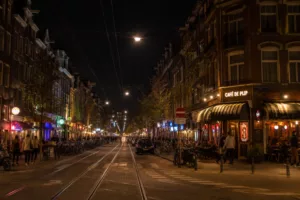
The neighbourhood moves naturally from dinner into drinks. Around Albert Cuyp and Ferdinand Bolstraat, you will find busy terraces, wine bars, cocktail spots, brown cafés and restaurants within a compact area. It feels social without feeling designed entirely for tourists.
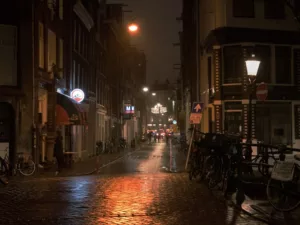
This is where you tell yourself you are having one drink after dinner, then discover that three hours have passed and somebody has suggested another bar.
The atmosphere is local, relaxed and easy to navigate on foot. That makes De Pijp especially good for mixed groups where one person wants cocktails, another wants beer and nobody wants to cross the city six times.
Our Self-Guided Food Tour De Pijp is a good way to understand the neighbourhood before the evening develops its own plans.
Leidseplein
Leidseplein is Amsterdam nightlife in its most visible form. It is busy, central and very easy for first-time visitors.

The strongest reason to come here is the music. Paradiso and Melkweg sit close by, and both can turn an ordinary evening into a concert or club night you did not know was happening.
The square itself is tourist-friendly and energetic, with plenty of bars, theatres and late-night food. It is not the most intimate version of Amsterdam, but it is convenient, lively and useful when a group wants options without much planning.
Check the programme before you arrive. Standing outside Paradiso and discovering your favourite artist played yesterday is an avoidable kind of sadness.
Amsterdam West and Sloterdijk
For serious electronic music, some of Amsterdam’s most important nightlife now sits west of the historic centre.
This wider area includes venues such as Lofi, BRET, Club RAUM and RADION. They are not places to visit simply because a generic list called them the best clubs. Choose a night whose line-up and atmosphere suit you.
This part of the city can feel less immediately picturesque than the canal belt. That is partly the point. Former industrial spaces, larger rooms and distance from the busiest tourist streets give these venues room to create something different.
If you are deciding how to divide your trip between central Amsterdam and other districts, our guide to how many days to spend in Amsterdam can help you plan without treating every evening as a race.
Amsterdam Noord
Amsterdam Noord gives the night a sense of departure before it has even started. You take the free ferry from behind Centraal Station and watch the city lights move across the IJ.

Noord mixes waterfront bars, creative venues, cultural spaces and electronic music. Shelter sits beneath the A’DAM Tower, while Parallel offers club nights, concerts and multidisciplinary programming.
Around NDSM, the old shipyard setting creates a completely different atmosphere from central Amsterdam.
Some evenings are built around a specific event. Others become drinks beside the water followed by a late ferry home.
Noord is best when you choose a destination or programme first. It is a large district, not one compact nightlife street.
Jordaan
Not every great night in Amsterdam needs a queue, a wristband or a sound system capable of reorganising your internal organs.
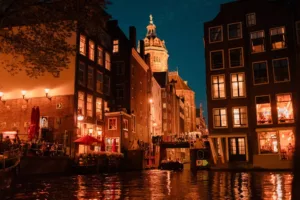
The Jordaan is where I would go for brown cafés, canal walks and long conversations. The streets are compact, the lighting is soft and the walk between cafés becomes part of the evening.
This is not the neighbourhood for club hopping. It is the neighbourhood for ordering one more drink because nobody can think of a convincing reason to leave.
Café Papeneiland, Café ‘t Smalle, Café de Tuin and other traditional cafés make the area feel distinctly Amsterdam.
The pace is slower, but the evening is no less memorable.
Rembrandtplein
Rembrandtplein is direct. The square is bright, busy and closely associated with mainstream bars and clubs.

This is a tourist-friendly choice for groups that want a recognisable nightlife district with plenty happening close together. AIR is nearby, and the streets around the square stay active late.
It can be noisy and chaotic, especially at weekends. That is not necessarily a criticism. Sometimes people want a calm wine bar. Sometimes they want a square where nobody appears remotely interested in going home.
For more underground electronic music, I would look further west or towards Noord. For an easy, energetic central night, Rembrandtplein does exactly what it promises.
Oud-West
Oud-West is one of the best areas for a more local evening built around dinner, cocktails, wine and neighbourhood bars.

De Hallen gives the area a useful starting point for food, drinks or a film, but the neighbourhood works best when you explore beyond one building.
The atmosphere is less theatrical than Leidseplein and less intense than Rembrandtplein. People meet after work, settle into restaurants and let dinner become drinks without making a formal announcement about it.
It is an excellent choice for couples or friends who want a lively evening without spending the entire night in a dedicated nightlife zone.
The Red Light District
The Red Light District is one of Amsterdam’s most famous areas, but it is not the centre of the city’s nightlife.
De Wallen is primarily known for adult entertainment. It is lively, there are bars, and its narrow streets can be extremely busy at night. But if somebody asks me where to find Amsterdam’s best clubs, live music or cocktail bars, this would not be my first recommendation.
It is still worth visiting. This is Amsterdam’s oldest neighbourhood, filled with historic buildings, canals and stories that are much more complex than its international reputation.
Go because you are curious about the area and its history, not because you have been told that all Amsterdam nightlife happens there. It represents one very visible part of the city after dark, not the whole story.
Once you have walked through it, continue elsewhere.
The wider city has far more to offer than one crowded set of streets.
How I would spend a perfect evening in Amsterdam
If somebody asked me to plan one evening that feels genuinely Amsterdam, I would not begin with a club map.
I would start with dinner somewhere we could take our time. Then I would walk through the canals while the city moved from evening into night.
I would stop for a drink in a brown café. Somewhere warm, small and full of people who seem completely unconcerned by the fact that tomorrow exists.
After that, the evening could go in several directions. Cocktails if we wanted to keep talking. Live jazz or a concert if the programme looked good. And if everyone still had energy, we could head to one of Amsterdam’s fantastic clubs.
For me, that is much more Amsterdam than simply club hopping until sunrise. The city is at its best when the evening changes pace: food, canals, conversation, music, then perhaps dancing.
Do not try to complete Amsterdam nightlife. Choose a version that feels right, leave some room for the night to surprise you, and check the last night bus before your phone reaches three percent.
FAQ: Amsterdam Nightlife and the Best Areas to Go Out
De Pijp is the easiest all-round choice for bars, restaurants and a lively local atmosphere. Jordaan is best for brown cafés, Leidseplein for concerts and tourist-friendly nightlife, and Amsterdam West or Sloterdijk for many of the city’s strongest electronic music venues.
Many bars close between 1 and 3 a.m., depending on their licence and the day of the week. Clubs often stay open later, commonly until 4 or 5 a.m., while specific events may continue beyond that. Check the official event page for exact times.
The legal drinking age is 18, and many venues are 18+. Some clubs and events are 21+, so check the age policy and bring valid photo identification.
No. It is one of the city’s most famous and busiest evening areas, but it is mainly associated with adult entertainment. Amsterdam’s best live music, cocktail bars, brown cafés and electronic clubs are spread across many other neighbourhoods.
That depends on the night. De Pijp, Jordaan and Oud-West are popular for drinks and restaurants. Noord and venues across West and Sloterdijk attract people for concerts, electronic music and club nights. Locals often choose the event or venue first rather than going to one permanent nightlife district.
Use the GVB app to check night buses and current routes. Taxis and ride-hailing services are also available. If you have been drinking, do not cycle home.
Want to experience Amsterdam with someone who actually lives here? Our walking tours are built on stories, not scripts. Small groups, real conversations, and the kind of local knowledge you can’t Google. Or if you’re looking for something more immersive, the Humans of Amsterdam cultural tour takes you deeper into the city’s stories and the people who live them. See all our tours and start your Amsterdam trip the right way.