
The smaller museums I’d choose when you want Amsterdam to explain itself.
Written by Alexandra, Founder of Who Is Amsterdam
Amsterdam has a museum problem: there are too many good ones.
Most first-time visitors book the Rijksmuseum, Van Gogh Museum and Anne Frank House, then discover halfway through day two that they have developed a condition I can only describe as museum legs. You are still interested.
Your brain is still trying. Your feet have resigned.
The big museums deserve their reputation. I love them too, and I am not going to tell you to skip Rembrandt because a smaller museum has fewer people in the gift shop.
But as someone who explains this city for a living, I find the smaller museums especially valuable. They explain how Amsterdam became Amsterdam.
We like to say that Amsterdam’s monumentality lies in the mentality of its people. These museums show you that mentality, and the best part is what happens afterwards: you step outside and recognise what you just learned in the streets around you.
If the weather is making the decision for you, our guide to what to do in Amsterdam when it rains has more indoor ideas. Here, I am staying with the museums I think earn their ticket even when the sun is out.
The Nine Museums at a Glance
| Museum | Best for | Approx. time |
| Museum of the Canals | First-time visitors, city history | 1 hour |
| Our Lord in the Attic | Religion, architecture, history | 1–1.5 hours |
| Resistance Museum | WWII history | 1.5–2 hours |
| STRAAT | Street art, contemporary culture | 1.5–2 hours |
| EYE Filmmuseum | Cinema, architecture, waterfront | 1–2 hours, excl. screenings |
| Museum Het Schip | Architecture, social history | 1–1.5 hours |
| National Maritime Museum | Maritime history, trade, water | 1.5–2.5 hours |
| Museum Van Loon | Canal-house interiors | 1 hour |
| Micropia | Science, curious adults and families | 1–1.5 hours |
Rough planning estimates, not official visit times.
1. Museum of the Canals: The One I’d Do First
If you have just arrived and the city still looks like a very attractive collection of bridges, start here.
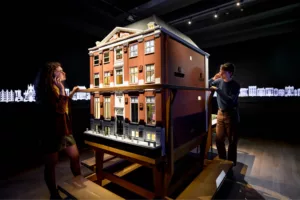
The Museum of the Canals on Herengracht explains why Amsterdam looks the way it does, using models, projections and audio rather than expecting you to develop a sudden passion for drainage maps. The main route takes roughly 45 minutes.
You come out understanding that the canal ring was not decoration. It was an enormous urban project: water management, building plots, merchant houses and transport, arranged on land that was not especially interested in becoming a capital.
And it wasn’t one person’s design. Planners, investors, builders and the city council worked with and against the water for decades. Managing water here has always required cooperation and practical problem-solving. You still feel that mentality in Dutch society today.
That knowledge travels with you. The narrow plots make sense. The shape of the city makes sense.
Even getting mildly annoyed because the bridge you need is farther away than expected becomes historically informed annoyance.
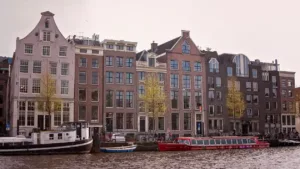
The museum sits inside a seventeenth-century canal house, with period rooms upstairs. If canal houses become a fascination, our guide to the story behind Amsterdam’s canal houses goes further.
This is the least glamorous recommendation on paper and one of the most useful in practice. Do it early. Everything afterwards reads better.
2. Our Lord in the Attic: The Museum That Sounds Made Up
You enter an ordinary seventeenth-century canal house, climb through kitchens, bedrooms and narrow passages, and eventually discover a church upstairs.
A proper one.
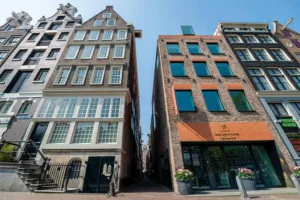
At Museum Our Lord in the Attic, the building is not a container for the story.
The building is the story.
The attic church was commissioned by Catholic merchant Jan Hartman and inaugurated in 1663, when Catholic public worship was prohibited. Private worship behind closed doors was tolerated, so a complete church was built across the upper floors of connected houses.
This tells you more about Amsterdam’s famous tolerance than a slogan ever could.
Historically, Dutch tolerance wasn’t about everyone agreeing or having equal rights. Catholics could not worship openly or hold public office. It was a pragmatic arrangement that let different communities live side by side, and everyone broadly understood the deal.
The stairs are steep and narrow, and the museum is not equally accessible to everyone, which is worth knowing before you arrive.
If mobility is not an issue, put it high on your list. It sits in the old centre, a short walk from Centraal Station and Nieuwmarkt.
3. Resistance Museum: WWII History Beyond One Famous Story
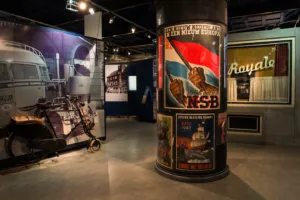
The Anne Frank House gives you one intimate and essential story of persecution. The Dutch Resistance Museum asks a wider question: what did people living in the Netherlands actually do when occupation changed ordinary life?
The museum is strongest when it refuses to turn history into a clean split between heroes and villains.
People resisted, collaborated, adapted, kept their heads down, made compromises, helped neighbours or benefited from the system. Propaganda, censorship, persecution, scarcity and fear become things people had to navigate every day.
The museum is in Plantage, where many Jewish Amsterdammers lived before the war. The National Holocaust Museum and the Hollandsche Schouwburg, where Jewish residents were assembled before deportation, are a short walk away.
If this history matters to your visit, give the neighbourhood time. The ticket includes an audio tour in several languages.
And don’t squeeze it between brunch and a cheerful canal cruise. Give it some space afterwards to let it settle.
4. STRAAT: Street Art on a Scale the Historic Centre Cannot Give You
The Rijksmuseum gives paintings monumental rooms. STRAAT Museum gives street art an entire industrial warehouse.
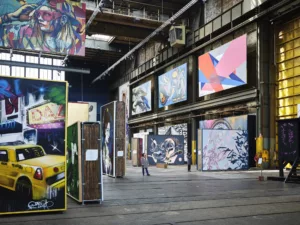
It sits at NDSM in Amsterdam Noord, once one of the biggest shipyards in the country. When shipbuilding stopped in the 1980s, artists moved into the empty halls, and the wharf slowly became the creative area it is today.
Take the free NDSM ferry from behind Centraal Station. The crossing pulls you away from the canal-house version of Amsterdam and into a landscape of cranes, warehouses and open water.
Inside, I would not overprepare. Walk in, react, and look from a distance as well as close up. The warehouse scale is half the point.
When you leave, don’t take the ferry straight back. Walk around NDSM, have a drink by the water and look back at the city. It is one of the places in our guide to alternative things to do in Amsterdam.
I like that STRAAT does not ask you to whisper politely in a white room, pretending you understood the wall label. The building has other plans.
5. EYE Filmmuseum: Go Even If You Don’t Think You’re a Film Person
You see EYE before you visit it. The white building sits across the IJ from Centraal Station looking like a spacecraft that misjudged the landing and decided the waterfront was acceptable.
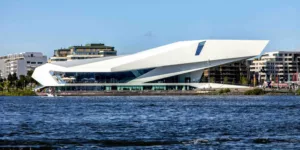
EYE Filmmuseum is part museum, part cinema, part archive and part very good excuse to take the free ferry to Noord.
Check the film programme. If something catches your eye, combine the exhibition with a screening and turn a grey afternoon into an evening. Exhibitions, cinema and restaurant can each have their own opening times, so check before you go.
The restaurant looks back across the water towards the city. The view is doing enough work that nobody needs to pretend they came only for the coffee.
Good to know: EYE and STRAAT are both in Noord, but not within easy walking distance. You can combine them in one Noord day, but plan the transport in between, for example the ferry back to Centraal and the NDSM ferry from there.
And the ferry ride is free. Amsterdam occasionally gives you a bargain. Accept it politely.
6. Museum Het Schip: Architecture With a Social Idea Behind It
Museum Het Schip is not in a grand canal house. That is the point.
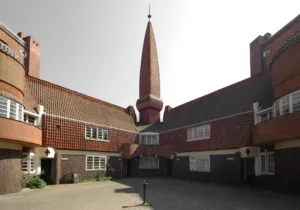
The Museum Het Schip occupies a social-housing complex designed by Michel de Klerk, a landmark of the Amsterdam School, the expressive architectural movement of brick, towers and decorative details.
Think about the contrast. The canal houses you have been admiring were built for wealthy seventeenth-century merchants. Three centuries later, Het Schip was built for working-class families, and its architects decided they deserved beauty too.
That was the social ambition: decent, beautiful housing should not be reserved for the wealthy.
Guided visits take you through a reconstructed slum dwelling, the former post office and a museum apartment. Afterwards, walk around the Spaarndammerbuurt. The city explains itself better when you leave the museum door and keep looking.
7. National Maritime Museum (Het Scheepvaartmuseum): Where Amsterdam’s Wealth Came From
Amsterdam without water would be a very different city. Actually, it probably wouldn’t exist in anything resembling the form we know today.
And while the canals are beautiful, water wasn’t originally designed to make your Instagram pictures look good. It was infrastructure, transportation, business and survival.
[Image needed: Alexandra’s own photo of the National Maritime Museum with the replica ship Amsterdam]
In the seventeenth century, a relatively small country became one of the great maritime and trading powers of its time. Het Scheepvaartmuseum tells that story: shipping, navigation, exploration, trade and life at sea.
The building alone is worth the visit: the Admiralty’s former naval storehouse from 1656, with a courtyard now covered by a spectacular glass roof inspired by old nautical charts.
Moored outside is a replica of the Amsterdam, an eighteenth-century ship of the Dutch East India Company (VOC). Access to parts of the ship can be limited, so check before you go.
The VOC deserves an honest word. It made Amsterdam extraordinarily rich, but that prosperity was also built on colonial violence, exploitation and slavery. A good visit leaves room for both.
This is the museum for anyone who wants to understand how such a small country gained such enormous international influence: trade, entrepreneurship, ambition at sea and the constant need to manage water.
You’ll find it at Kattenburgerplein 1, a 15 to 20-minute walk from Centraal Station, next to NEMO. Give it about two hours, and combine it with the Eastern Docklands or Plantage.
8. Museum Van Loon: See a Canal House From the Inside
One of my favourite things about Amsterdam is that people often leave their curtains open. In the evening, when the lights are on, you catch little glimpses of beautiful homes and everyday life. I call it secondhand happiness.
But obviously, there’s a limit to how much looking through somebody’s window is socially acceptable. 😂 Museum Van Loon solves that problem beautifully.
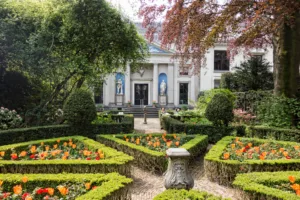
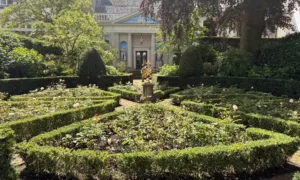
The house at Keizersgracht 672 dates to the seventeenth century and was later home to generations of the Van Loon family. At Museum Van Loon you move through furnished rooms and family portraits, then out to the garden and coach house.
From the canal, these houses present a narrow public face. Inside, they stretch much farther than you expect, with gardens and service spaces hidden from the street.
Don’t expect the scale of a national museum. The value is intimacy. An hour here improves the next several hours outside. That is my favourite kind of museum.
9. Micropia: For the Point in the Trip When You Need Something Completely Different
By now we have covered canals, religion, war, street art, cinema, architecture and the sea. You may be ready for microbes.
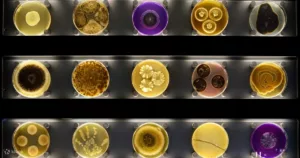
ARTIS-Micropia is dedicated to the microscopic life living around, on and inside us, with living microorganisms and interactive exhibits.
There is a kiss-o-meter measuring microbial exchange during a kiss. This is a sentence the Rijksmuseum has never needed.
It works well with curious children and teenagers, but it is not just a children’s museum. Give it an hour to ninety minutes and combine it with a walk through Plantage.
If the phrase “Dutch Master” now causes a small involuntary sigh, go look at bacteria. It may save the afternoon.
If You Only Have Time for Two, Choose by What You Want to Understand
There is no correct pair. These are pairings by theme, not by location.
Understanding Amsterdam: Museum of the Canals and Our Lord in the Attic.
Maritime history and trade: National Maritime Museum and Museum of the Canals.
Dutch social history: Resistance Museum and Museum Het Schip.
Contemporary art and film: STRAAT and EYE, with transport planned in between.
Architecture and social class: Museum Van Loon and Museum Het Schip.
Something different: Micropia plus whichever museum matches your interests.
Smaller does not mean secondary. It often means specific: you understand one thing properly, leave before exhaustion arrives and continue into the neighbourhood that produced the story.
Wondering how many museum days your trip needs at all? Our guide to how many days to spend in Amsterdam helps you avoid a four-day holiday spent almost entirely indoors.
But don’t spend your whole trip indoors. Take what you’ve learned back onto the streets, where Amsterdam keeps telling its story. If you’d like a local to help you read them, that’s exactly what we do on our walking tours.