
The unwritten rules of Amsterdam, explained by a local, and why the city works the way it does.
Written by Alexandra, Founder of Who Is Amsterdam
Amsterdam has a reputation: the city where everything is allowed.
That’s not quite how we see it.
Amsterdam is a “live and let live” city. You can be who you want to be here. But live and let live works in both directions. It also means being aware of the people around you.
Most of our unwritten rules come down to that one idea. Once you understand where it comes from, the rest makes sense.
And honestly? Simply be kind and mindful, and you’ll be fine.
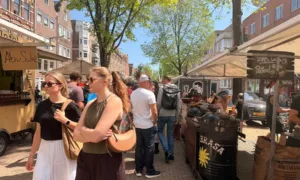
Amsterdam Etiquette in One Sentence
Do whatever you want, as long as you’re aware of your neighbour. And be respectful.
That’s it. That’s our attitude. Everything below is just that principle applied to bikes, photos, the Red Light District, coffeeshops and conversation.
Why Amsterdam Works This Way: Pragmatism First
People often say Amsterdam is tolerant. That’s true, but it isn’t the full story.
At its core, Amsterdam is pragmatic.
We have always had to fight the water. Keeping our heads above it, literally, meant working together and being aware of each other. You can’t keep a city dry on your own.
Amsterdam is also a trading city. To do business with the whole world, you have to be tolerant of the whole world. Tolerance and equality are, in a way, byproducts of that pragmatism. We needed them to make money, and in many ways that’s still true.
The result is a highly international city, home to around 180 nationalities.
Is it perfect? No. But it works. Living together with so many different people means we sometimes have to be okay with not being okay, together.
That’s live and let live. And it’s why the rules below aren’t really about rules at all. They’re about sharing space.
A Cosmopolitan Village
Here’s something many visitors don’t expect: the historic centre is small.
Amsterdam feels like a cosmopolitan village. International, lively and full of culture, but squeezed into narrow streets and canal-side lanes that were laid out centuries ago, long before cars, coaches or millions of visitors.
There’s a lot of water and not much space. That’s exactly why we cycle. It’s simply the most efficient way to get around a compact city full of canals.
Space is precious here. Most of the etiquette tips below are really about one thing: sharing that small space with the people who live and work in it.
The Unwritten Rules Tourists Don’t Know
1. That “Pathway” Is Probably a Bike Lane
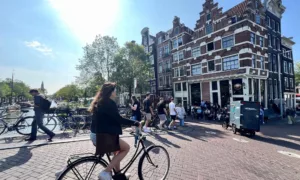
In the city centre, many streets look like pleasant little pathways. They’re not.
Bike lanes are often red, sometimes only marked by a line, and sometimes the whole street is shared with bikes. If you step onto one without looking, you will hear a bell. Probably several.
Look both ways, look again for bikes, and never stop in a bike lane to take a photo or check your map.
2. Bikes Are Transport, Not an Attraction
For us, a bike isn’t a fun holiday activity. It’s how we get from A to B: to work, to school, to the supermarket.
So I’ll be honest: locals are often a bit annoyed by tourists who rent a bike because “it’s a great thing to do in Amsterdam”.
I get it. It looks fun. But you’re joining real traffic in a busy city where people cycle fast and confidently.
If you’re not an experienced cyclist, please don’t bike in the city centre. Walk, take the tram or the ferry instead.
If you do decide to cycle, avoid the morning and late-afternoon rush hours, keep to the right, signal with your hand and never stop suddenly in the middle of the lane.
Read our full guide on why bikes rule Amsterdam (and how not to get hit by one) before you rent one.
3. Use the Pavement, Even When It’s Narrow
Some pavements in the centre are barely wide enough for one person. Use them anyway.
Walking in the middle of the street, or walking four people side by side, blocks bikes, delivery vans and locals trying to get home.
If you want to stop, step aside. If you want to look at a map, find a corner. Small city, shared space.
4. Be Mindful of Where You Take Photos
Amsterdam is beautiful, and you will want to photograph everything. Go for it, but be aware of where you’re standing and who you’re photographing.
Don’t block a bike lane or a narrow bridge for the perfect shot. Don’t sit on someone’s doorstep or houseboat for your photo. And remember that the canal houses are people’s homes, not a film set.
Many of us leave our curtains open, but that’s not an invitation to photograph the people inside.
5. How to Act and Behave in Amsterdam’s Red Light District
Yes, let’s talk about the Red Light District.
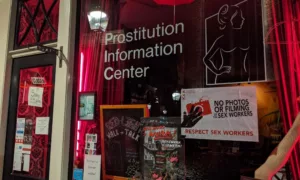
Sex work is legal and regulated in the Netherlands. The people working behind the windows are doing their job, and we respect them.
That means one very clear rule: no photos or videos of the sex workers. Not openly, not secretly, not “just of the street” with a window in the background. Put your phone away.
The Red Light District is also a residential neighbourhood, one of the oldest parts of the city, with homes, churches and cafés. Treat it that way.
Don’t be unaware of what is going on there. Inform yourself before you go, walk through respectfully, keep your voice down at night and don’t stand in front of the windows staring or laughing.
6. Coffeeshops: Be Aware of Your Neighbour
Coffeeshops are part of Amsterdam, and you’re welcome to visit one. But the same principle applies: do what you want, but be aware of the people around you.
Smoke inside the coffeeshop. Don’t smoke in front of children, outside schools or on crowded streets.
Good to know: since 2023, smoking cannabis on the street in the Red Light District is banned, and you can be fined for it.
If you’re new to it, start slowly. Edibles in particular can be much stronger than people expect.
For everything else, read our guide to Amsterdam coffeeshops for first-time visitors.
7. Freedom Doesn’t Mean Going Completely Wild
You can have a wild night in Amsterdam. Many people do, and that’s fine.
But freedom here comes with awareness. People live in the city centre. Their children are sleeping above the bar you’re leaving at 2 a.m.
Keep the noise down on the streets at night. Don’t urinate in the canals or on the street. Don’t treat the city like a theme park.
Go wild if you like. Just stay aware of the locals.
8. On Trams and Metros: Check In, Check Out, Let People Off
Public transport has its own little etiquette.
Always check in when you get on and check out when you get off. You can simply tap your contactless bank card or phone at the card reader. Forget to check out, and you may pay more than you should.
Let people get off before you get on. Move inside instead of standing in the doorway with your suitcase. And on escalators, stand on the right so people in a hurry can pass on the left.
Everything you need to know is in our guide to Amsterdam public transport for tourists.
Dutch Directness Isn’t Rudeness
The Dutch can be quite direct.
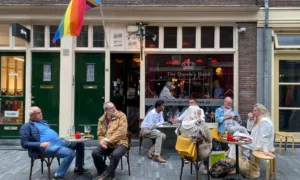
Ask a question, and you’ll get an answer. Not always the one you hoped for, and not always wrapped in politeness.
That directness is born from the same pragmatism. Why spend five minutes approaching the point when you can just make it?
So please don’t take it personally. Most of the time, it simply means we’re being clear and honest with you. You’ll always know where you stand.
Don’t Brag: Equality Is a Thing Here
Bragging is absolutely not part of Dutch culture.
Equality matters here. Your manager is called by their first name. People rarely show off wealth or status. And if you start bragging or putting yourself above others, you will notice. Someone will probably tell you. Directly.
There’s a well-known Dutch saying: Doe maar normaal, dan doe je al gek genoeg. Just act normal, that’s crazy enough already.
It sums up the attitude perfectly. Be yourself, but don’t act as if you’re better than anyone else.
Greetings, Small Talk and First Names
Dutch greetings are simple and friendly.
When you meet someone for the first time, a firm handshake, eye contact and your first name are the norm. Friends and family often greet each other with three kisses on the cheek. Don’t worry, nobody expects that from a visitor.
In shops and cafés, a simple “hoi” or “goedemorgen” (good morning) when you come in, and “dank je wel” and “doei” (bye) when you leave, will earn you a smile.
Small talk tends to be short. People may ask what you do or where you’re from, then get straight to the point. It’s not cold. It’s just efficient.
Should I Be Tipping in the Netherlands?
Tipping is welcome here, but it isn’t mandatory.
Service staff in the Netherlands are paid a regular wage. Not a fortune, but well enough that they don’t depend on tips the way they do in some countries.
So tip for good service. If you had a lovely meal and friendly service, 5% to 10% is a nice gesture, or simply round up the bill.
If the service wasn’t good? Don’t tip. No hard feelings. We reward the service level, and nobody will chase you down the street.
Most importantly: don’t feel guilty either way.
Eating Out the Dutch Way
A few habits that surprise visitors in restaurants:
We eat early. Many Dutch people have dinner between 18:00 and 19:00. Restaurants in the centre stay open later for visitors, but in the neighbourhoods, kitchens can close earlier than you might expect.
You have to ask for the bill. Staff won’t bring it until you ask. That’s not slow service. It means you’re welcome to stay as long as you like.
Splitting the bill is normal. “Going Dutch” exists for a reason. Friends often split the bill or pay each other back afterwards with a payment request on their phone, called a Tikkie.
Card is king. Most places accept cards, and some don’t accept cash at all. It’s worth checking before you sit down if you only have cash on you.
Amsterdam Is Working on It Too
Living with millions of visitors in a small city isn’t always easy, and Amsterdam is actively looking for a better balance between residents and tourism.
During the corona years, I worked with I amsterdam on a sustainable-tourism project. It showed me how much the city wants visitors to discover more than the busiest streets, and to experience Amsterdam as a place where people live, not just a destination.
You can help without much effort. Explore neighbourhoods beyond the centre. Visit in quieter months. Support local, independent shops and cafés. And follow the simple rules in this guide.
Small choices from a lot of visitors make a big difference for the people who call this city home.
What You Don’t Need to Worry About
Not everything needs a rulebook. A few things visitors often worry about, but don’t need to:
Is the Red Light District safe? Yes, it is. It has a special atmosphere, especially at night, so inform yourself beforehand and keep an eye on your belongings as you would in any busy area. Respect the no-photo rule and you’ll be fine.
Do I need to speak Dutch? No. Most people in Amsterdam speak excellent English. A simple dank je wel (thank you) is always appreciated, though.
Will I get it wrong? Probably, at some point. Everyone does. A quick sorry and a smile go a long way.
Live and Let Live
Amsterdam isn’t a city of strict rules. It’s a city of awareness.
Stay off the bike lanes. Use the pavement, even when it’s narrow. Think about where you take your photos. Respect the people who live and work here. And don’t bike if you’re not experienced.
Other than that? Simply be kind and nice, and you’ll be fine.
Want to understand this mentality better? Read why Amsterdam is so different from other European cities.
Want to understand the mentality behind it all? That’s exactly what we talk about on our Hello Amsterdam Walking Tour. Have a look at all our walking tours.