
A local look at why Amsterdam feels different than other cities
Written by Alexandra, Founder of Who Is Amsterdam
When I first came to Amsterdam for an internship around 23 years ago, I had no idea it would eventually become my home.
I remember immediately falling in love with what I now call Amsterdam’s cosmopolitan village feeling.
Other cities, especially other capitals, often seem to say: let’s make this huge and impressive. Amsterdam somehow seems to have said: nah, let’s make the whole thing cute.
The houses are not enormous. Half of them appear to be leaning against each other. There is water everywhere, people are cycling past you and everything feels incredibly beautiful but also very human.
It is just very gezellig.
Twenty-three years later, after living here for most of that time and showing thousands of travellers around Amsterdam, I understand much better what creates that feeling.
People arrive knowing they are supposed to notice the canals, bicycles, tall houses and perhaps the Red Light District. All of those things are here.
But after a day or two, the canals stop looking like attractions and become streets. The bicycles stop being charming and start becoming traffic. The seventeenth-century houses you photographed in the morning have people cooking dinner behind the windows by evening.
That shift is part of what makes Amsterdam unique. People actually live inside the postcard.
They cycle through it on their way to work, collect children from school in it and argue about construction work in buildings that visitors crossed continents to photograph.
Amsterdam is beautiful.
But it rarely behaves as though beauty is its main job.
Amsterdam Is a Cosmopolitan Village
Amsterdam is a cosmopolitan village. That contradiction is one of the main reasons it feels so different from other European capitals.
It is an international capital with global companies, world-famous museums, major cultural institutions, nightlife, events and people from all over the world. But you can still have your baker, your brown café, your market person and your favourite bench.
Compared with capitals such as London or Berlin, Amsterdam is extraordinarily compact. Those cities can feel enormous, with long distances, monumental buildings and neighbourhoods that function almost like separate cities.
Amsterdam generally does not dwarf you. The Zuidas business district and outer neighbourhoods introduce different architecture, but much of the city remains relatively human-scale and down-to-earth.
It also feels smaller because moving around is so easy. Walk, cycle, take a tram, metro or ferry and you are very quickly somewhere else.
Water divides the city into small pockets, while excellent public transport and cycling stitch those pockets back together.
Amsterdam is also the Dutch capital, but the national government, parliament, ministries and main political institutions are in The Hague.
That matters. Amsterdam does not have the same concentration of national government and political formality found in many capitals.
It feels more like a city where people live, work, create, trade, eat, argue, cycle and meet each other than a city built around the machinery of government.
The result is a strange history bubble with completely normal modern life happening inside it.
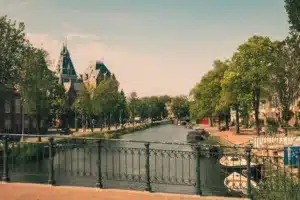
The houses lean. Things are crooked. A building is 300 years old and somebody has installed a questionable modern kitchen. A bicycle is chained to something it probably should not be chained to. History is not behind a velvet rope here. We are living in it.
If you want to see how quickly that atmosphere changes even within the historic centre, our guide to Amsterdam’s most beautiful canal walks follows Brouwersgracht, Prinsengracht, the Nine Streets and some of the quieter stretches where the city becomes easier to notice.
One of the details visitors notice is how easily they can see into people’s homes. Amsterdammers famously do not always close their curtains.
I am not suggesting that visitors should stand staring into somebody’s living room. But walking beside the canals in the evening and catching small glimpses of people having dinner, reading or sitting with friends beneath beautiful lamps can create a kind of secondhand happiness.
It is transparent and gezellig. It makes the historic city feel alive rather than preserved, and it connects with Dutch ideas around openness, practicality and privacy.
The international city and the intimate daily city occupy the same streets. That is the cosmopolitan-village feeling.
The official I amsterdam neighbourhood guide makes the same distinction: Amsterdam extends far beyond the famous canal ring, and its districts have noticeably different characters.
For someone wondering why Amsterdam is different, I would begin with that contradiction.
Daily life is not hidden behind the historic city.
It is happening inside it.
Amsterdam Was Built Around Water
The canals are usually introduced as the pretty part.
They deserve more credit.
Amsterdam’s seventeenth-century canal belt was a huge piece of urban planning and hydraulic engineering. The city expanded over difficult wet ground through canals, drainage, land reclamation and a deliberate network of residential and commercial streets.
UNESCO’s description of Amsterdam’s canal ring calls it an exceptional example of large-scale hydraulic and urban planning. It influenced where people built, how goods moved and how new parts of the city developed.
Water is not decoration here. For centuries, canals, dikes, polders, drainage and pumping have required people to organise everyday life around a difficult landscape.
There is also a social idea inside that engineering. If everybody depends on the same dike, what your neighbour does matters to you too. Managing water required cooperation, rules and practical decisions long before visitors began photographing the canals.
The landscape shaped the urban plan, and both helped shape a Dutch mentality that values cooperation while remaining intensely practical.
You still feel that structure today. Walk through the canal belt and a straight journey rarely remains straight for long.
Turn down another street because the house on the corner looked interesting. Arrive somewhere you did not technically intend to visit.
This is normal.
Amsterdam has been ruining efficient walking routes beautifully for centuries. Then came another important decision. The city did not surrender its centre completely to the car.
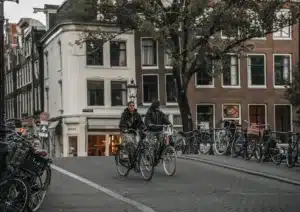
Amsterdam’s own Bike City history explains how twentieth-century policy moved towards a compact city where bicycles and public transport were prioritised and car traffic was increasingly restricted.
That history matters because Amsterdam cycling culture is not a tourist attraction or a lifestyle commercial.
We do not cycle because we are all performing an idyllic Dutch lifestyle. We cycle because we need to get from A to B, and we are probably late.
For many Amsterdammers, a bicycle serves the practical everyday role a car serves elsewhere. People cycle to work, school and meetings, sometimes while transporting two children, groceries and what appears to be a small forest in a cargo bike.
That is why cycle lanes are serious transport infrastructure. Randomly stopping in one is dangerous, and ringing a bicycle bell for fun is not nearly as charming to the person trying to get home.
Bridges handle bicycles, pedestrians, trams and cars in the same limited space, while boats use another layer beneath everyone. Compared with cities designed heavily around cars, Amsterdam’s centre gives far more priority to cycling, walking and public transport.
If you are coming to Amsterdam for the first time, read our guide on what not to do in Amsterdam before deciding that the red bicycle lane looks like an excellent place to stop and check Google Maps.
It is not.
Someone behind you already has an opinion about this.
Everyday Life Has a Different Rhythm
The physical city explains part of Amsterdam.
People explain the rest.
There is a practicality to Amsterdam culture that visitors sometimes mistake for coldness.
Ask a Dutch person a question and there is a reasonable chance they will answer the question you asked.
Exactly that question.
Without first wrapping the response in several layers of encouragement.
I have watched visitors experience Dutch directness in real time.
Then: “Oh.”
Then, five minutes later: “You know what, fair enough.”
The philosophy is often simple: you do you, I do me. Tell me what you want, I will tell you what I think, and then we move on.
Clarity is frequently considered more useful than wrapping an answer in ten layers of politeness. Of course, sometimes somebody really is simply rude. We cannot blame Calvinism for every unpleasant person in Amsterdam.
But much of what visitors first interpret as coldness is cultural directness combined with practicality.
The same practicality appears in how the city uses public space. Private homes can be small, so daily life spills outward.

The moment the weather becomes remotely acceptable, people move onto terraces, canal sides, parks, boats and benches. They sit outside their houses and turn the city into shared living space.
Children move through the city independently at an age that sometimes surprises visitors. A café table can remain occupied for a long time because nobody is trying to turn your coffee into a twenty-minute appointment.
This is one reason Amsterdam lifestyle is difficult to understand through attractions alone.
Go to the Rijksmuseum and you learn something important about the Netherlands. Spend forty minutes in a neighbourhood café at 17:00 and you learn something else.
Brown cafés belong to this story too. They are neighbourhood institutions and often feel like extensions of people’s living rooms.
A city can receive millions of visitors and still contain a tiny café with six tables, old wood, candles, a beer and the same regulars sitting where they have sat for years. That is Amsterdam’s global-and-local contradiction in one room.
Amsterdam’s international character is visible in who lives here, the languages spoken around you and what the city eats. Indonesian and Surinamese food, Turkish and Moroccan influences, and streets such as Javastraat make that history tangible.
De Pijp and Oost show different versions of that mix through markets, restaurants, homes, cultural venues and community spaces. Amsterdam did not suddenly become international when people started using the word expat; it has been outward-facing for centuries.
That international history also includes colonialism, exploitation and inequality, so it should not be romanticised. But it is fundamental to understanding modern Amsterdam.
The city can also be surprisingly chatty. Somebody comments while you wait for a tram, a person beside you starts talking at a bar, or somebody overhears a conversation and joins in when they sense you are open to it.
Not everybody is walking around trying to make new friends, but the informality often surprises people who expect a northern European capital to feel socially cold. Again: cosmopolitan village.
Amsterdam’s Famous Freedom Comes With Boundaries

This is probably the most misunderstood part of what Amsterdam is known for.
The best summary is: live and let live, but do not bother everybody else.
Want to live differently, dress differently, be gay or believe something different? Fine.
But personal freedom does not automatically give anybody the right to create a nuisance for everyone around them.
This helps explain an Amsterdam contradiction: the city is liberal, and it has a lot of rules.
Amsterdam’s reputation grew from a long, complicated history of trade, intellectual exchange, religious tolerance and personal autonomy. It now includes visible LGBTQ+ life, regulated sex work and space for different lifestyles, although the reality has never been as simple or equal as the mythology.
The interesting question is not whether Amsterdam approves of everything. It is how the city deals with realities that already exist instead of pretending they do not.
That is where pragmatism enters the story.
Freedom here has never meant an absence of boundaries.
Cannabis is one example, not the whole explanation.
The Dutch tolerance policy allows coffeeshop sales under strict conditions even though selling cannabis remains illegal under national law. The rules cover age, quantities, advertising, hard drugs and nuisance.
It is regulation built around a pragmatic question:
If something exists, how do we manage reality responsibly?
Visitors sometimes translate tolerance into: Amsterdam does not care what you do.
Amsterdam cares quite a lot, especially when private freedom becomes public nuisance.
The municipality explicitly rejects the tourism image that anything goes. Rules target nuisance, disruptive behaviour and overcrowding because residents’ quality of life is part of the calculation.
Liberalism and regulation are not necessarily opposites here.
The city can tolerate something and regulate it heavily at the same time.
It can defend personal freedom and still tell you to stop behaving like an idiot outside somebody’s apartment at 2:00 in the morning.
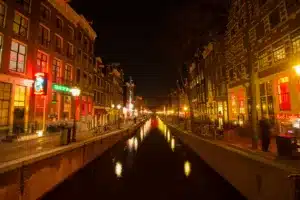
The Red Light District demonstrates this better than almost anywhere.
If you want to understand Amsterdam’s famous openness rather than repeat the usual headlines, the Humans of Amsterdam Cultural Walking Tour follows this exact idea. Guests walk through Jordaan, the canal belt and the old centre, then meet Amsterdammers whose lives connect to migration, activism and entrepreneurship.
Those conversations make Amsterdam harder to summarise.
Good.
Cities usually become more interesting when the simple explanation stops working.
A Cosmopolitan Village of Neighbourhoods
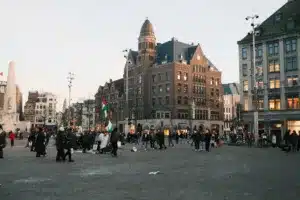
Within a relatively short distance, Amsterdam changes character several times.
The historic Canal Belt becomes the former working-class Jordaan, then busy international De Pijp, multicultural Oost and industrial-creative Noord.
Jordaan has narrow streets, old cafés and canal houses. De Pijp feels busier and younger, built around street life, restaurants and Albert Cuyp Market.
Oost spreads out through residential streets, parks, markets and cultural venues shaped by a diverse population.
Then a free ferry carries you across the IJ.
Noord looks like somebody changed cities while you were on the ferry, combining green areas and small village environments with industrial buildings, modern cultural spaces and waterside development.
Because Amsterdam is compact and well connected, those contrasts arrive quickly. That is what makes the neighbourhood structure interesting.
You can have a favourite baker.
A brown café where somebody knows your order.
A market person who recognises you.
A favourite bench and a neighbour you keep bumping into.
All within an international capital visited by millions of people. Global and local at the same time.
Jordaan is a good example.
It has changed enormously and become far wealthier than its working-class origins would suggest, but Amsterdam still describes a strong community character among the galleries, cafés, museums and increasingly expensive streets.
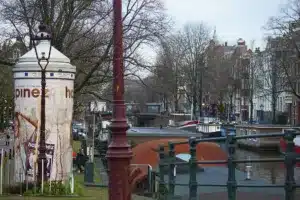
This is one reason visitors often tell me Amsterdam feels accessible.
You learn pieces of it quickly.
Not all of it.
That would be suspicious.
But enough that after three days you start saying things like, “We’ll go back to that place in Jordaan,” as though you have been maintaining a local routine for years.
The current official neighbourhood guide actively encourages visitors to move beyond the canal ring because each part of Amsterdam has its own character.
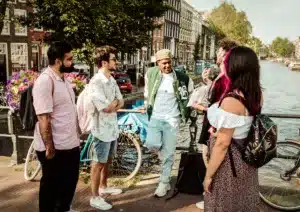
If this is your first visit and you want to understand how these pieces fit together before exploring alone, the Hello Amsterdam Walking Tour is our compact introduction to the city. It covers the historic centre and canal belt while connecting the architecture and landmarks to present-day Amsterdam, Dutch values and everyday life.
I would do something like that early.
Then leave.
Go to another neighbourhood.
That is usually when Amsterdam starts becoming yours.
So, What Actually Makes Amsterdam Unique?
If somebody asked me why is Amsterdam unique, I would not say canals.
Plenty of cities have water.
I would not say bicycles either.
There are excellent cycling cities elsewhere.
I think the difference is how all these things sit together.
Amsterdam took an inconvenient landscape and designed a city around it. That design created a compact place where water, buildings and people remain physically close.
Cycling then reinforced that human scale. Trade made Amsterdam international early.
Migration kept changing who lived here and what the city ate, spoke about and argued over.
A tradition of pragmatism produced policies that outsiders sometimes interpret as radical, while locals often see them as attempts to manage reality.
And the neighbourhoods stopped the whole thing becoming one enormous tourist centre.
Together, those forces created a cosmopolitan village: international but intimate, historic but lived-in, liberal but organised.
That combination creates the feeling people notice. History is everywhere, but Amsterdam does not handle it with white gloves.
A seventeenth-century canal house can contain an office, a family and a terrible kitchen renovation. A medieval street can contain a queer bar, a coffeeshop, an old church and somebody wheeling groceries home.
That, for me, is the answer.
What makes Amsterdam unique is not one unusual attraction.
It is how unusual things become ordinary here.
The canals are infrastructure.
Historic neighbourhoods continue changing.
People live in the postcard.
You can spend a weekend photographing Amsterdam and leave with excellent photographs.
Or you can pay attention to how the place works.
That version stays with you longer.
Frequently Asked Questions
Amsterdam combines the culture and diversity of an international capital with a compact, human-scale physical city. Historic buildings remain part of ordinary life, neighbourhoods change quickly and the national government is based in The Hague rather than Amsterdam.
The historic centre is compact, neighbourhoods sit close together and the street network rewards wandering. Canals can interrupt the straight route, but walking remains one of the easiest ways to move between major central areas.
Cycling is everyday transport rather than a tourist novelty. Decades of policy prioritised bicycles and public transport, while Amsterdam’s compact scale makes many daily journeys faster and easier by bike than by car.
Amsterdam has a long and complicated reputation for religious tolerance, personal autonomy, LGBTQ+ life and pragmatic regulation. The local principle is closer to live and let live, but do not bother everybody else, than to anything goes.
Compared with cities such as London or Berlin, Amsterdam covers daily distances on a much more manageable scale. Human-scale architecture, strong public transport, cycling and water-divided neighbourhoods make the city feel like a connected collection of smaller places.
Amsterdam culture combines directness, practicality, international influences, neighbourhood familiarity and a strong use of shared public space. It is common to move from a globally recognised institution to a tiny brown café where everybody knows each other within a few minutes.
Experience Amsterdam Beyond the Obvious
Two experiences connect most directly with the story in this article.
Choose the Hello Amsterdam Walking Tour if you want Amsterdam to make sense, or the Humans of Amsterdam Cultural Walking Tour if you want to understand the people behind the city.
If your focus is specifically art, the Private Rijksmuseum Tour remains available, or you can explore all Who Is Amsterdam tours if another experience better matches your interests.