
A neighbor-to-neighbor guide to what will feel familiar, what will not, and how to spend a weekend well.
Written by Alexandra, Founder of Who Is Amsterdam
Look, I grew up in beautiful Hamburg. When I first came to Amsterdam, around 23 years ago during my studies, I was immediately struck by how compact, cosy and informal it felt compared with the German cities I knew. I fell in love, and I moved here. I’ve now lived here for 18 years.
That’s what I always call the cosmopolitan village feeling. Amsterdam is an international capital, but somehow it feels like a village. You’ll notice that contrast everywhere.
So comparing Germany and Amsterdam is something I can do very well.
We’re neighbours, absolutely. Learning Dutch was much easier for me than for a lot of people, because the languages are similar. But it’s still a different language, and it took real work to get the nuances. Now I speak it fluently, and it taught me something: Dutch is more practical and to the point. That explains a lot about Dutch directness.
And there are a lot of Germans here. Not just in Amsterdam: whenever I go to the beach, I hear German everywhere.
If you are coming from Germany for two or three days, here is what will feel familiar, what may surprise you, and how I would use the weekend.
1. Why Amsterdam Feels Familiar to German Visitors – Until It Doesn’t
We’re neighbours, and there’s a lot of respect between us. Plus a little football rivalry, which has always been there. There are plenty of similarities, but also real differences.
The Netherlands is a small country, but a proud and liberal one, and very good at business. So are the Germans, of course, but in a different way. Germany is more industrial: it makes things. The Netherlands is much more a service economy: the Dutch trade and serve. It’s no coincidence that Rotterdam is Europe’s biggest port.
The differences are more interesting at street level.
Amsterdam’s historic centre simply feels more compact and human-scale than many German cities. The canal belt dates from the 1600s, and most of the neighbourhoods around it from the 1800s and 1900s, so the city was shaped by waterways and narrow streets rather than by traffic. We cycle, and we have the infrastructure for it. That’s exactly what I see Germans enjoy most here: they can walk and bike almost everywhere.
The city gets small quickly.
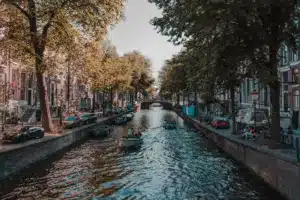
That compactness changes how you travel. The canal belt, Jordaan, Nine Streets and historic centre connect naturally on foot. Museumplein and De Pijp make sense as part of the same day. A tram can be useful, but sometimes walking to the next neighbourhood takes less thought than working out which tram will save you seven minutes.
For German tourists visiting Amsterdam, I think this is why starting on foot works so well.
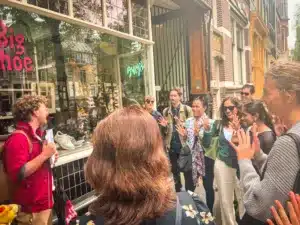
The Hello Amsterdam Walking Tour is designed as a two-hour first introduction to exactly these layers: the historic centre, canal belt, architecture, cycling culture and Dutch mentality. It begins at Dam Square and finishes by Westerkerk, right beside the Jordaan, so the rest of the afternoon can continue naturally rather than ending with everyone standing around asking what comes next.
2. See the Famous Amsterdam – Then Find What Germany Cannot Give You
See the famous places that matter to you, then let the neighbourhood around them do the rest. You don’t need me to explain the Rijksmuseum or the Jordaan from scratch, so here’s just what I’d tell a German friend.
Let the Canal Belt Lead You Into Everyday Amsterdam
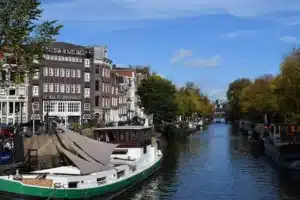
I would start somewhere around Brouwersgracht or the western canal ring and move into Jordaan through streets around Egelantiersgracht and Bloemgracht.
Find a café, look into the small shops and follow the street that seems interesting. A weekend from Germany is close enough that you do not have to behave as though every famous sight must fit into this one visit.
Our guide to alternative things to do in Amsterdam is useful when you want more of that side of the city. It moves beyond the headline attractions into Noord, Plantage, brown cafés, neighbourhood markets and smaller cultural spaces.
Choose One Major Museum – and Read It as a Neighbour
For Dutch art and history, choose the Rijksmuseum. If Van Gogh is the reason you are excited to come, choose the Van Gogh Museum. Trying to do both back-to-back sounds efficient until the second museum, when everybody is looking at a masterpiece while thinking mostly about lunch.
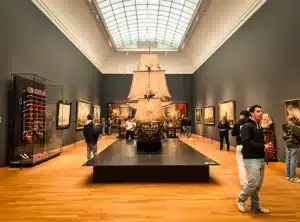
For people who prefer context to wandering through rooms hoping the important objects explain themselves, the Private Rijksmuseum Tour connects major works to the people, politics and money around them.
Then there is the Anne Frank House.
If it’s important to you, plan ahead. Tickets are only sold through the official Anne Frank House website, and they’re released six weeks in advance, every Tuesday at 10:00. Set a reminder, because they go fast. Don’t assume that because Germany is nearby, you can decide on Saturday morning to go.
If your dates already appear sold out, the Who Is Amsterdam guide to last-minute Anne Frank House tickets explains what options remain without sending you towards unofficial sellers.
3. Eat the Amsterdam That Germany Cannot Give You at Home
German visitors do not need an enthusiastic explanation of bread, cheese, potatoes, sausages or beer.
There is enough culinary overlap between neighbours that the interesting part is not proving the Dutch also know how to fry something.
Start with bitterballen. My German friends are obsessed with them: whenever I go back to Germany, I bring a cool box full of frozen bitterballen for their air fryers. Then try poffertjes, a kroket for lunch, and herring if curiosity wins.
Notice the ritual, too. Shared borrelhapjes on the table matter as much as the snack itself.
A warm stroopwafel is considerably better than the packaged version.
Then keep going.
My message: don’t just come here for pancakes and stroopwafels. Amsterdam has an incredibly international food culture, shaped by centuries of trade, migration and colonial history.
My biggest food tip: Indonesian. You won’t find much of it in Germany, but in Amsterdam it’s huge. Go for a rijsttafel, a whole table of small Indonesian dishes, or grab something from one of the Indonesian tokos, the little takeaway shops.
Whenever my friends from Germany visit, and whenever I recommend it to our guests, they’re in awe at how good it is.
Then try Surinamese roti. And look out for the Turkish, Moroccan and other kitchens that have changed what Amsterdam’s neighbourhoods eat, sell and cook.
Markets Make an Easy Introduction
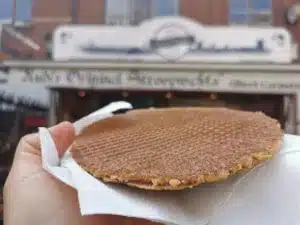
Albert Cuyp Market in De Pijp is the obvious starting point.
It is well known to visitors, but that does not make it fake. The market is still part of daily neighbourhood life, and you can move from Dutch fish and stroopwafels to Surinamese, Turkish and other international food without leaving the same street.
Dappermarkt in Oost feels more local and multicultural. Noordermarkt and Lindengracht work particularly well when your day is already centred on the Jordaan.
The Who Is Amsterdam guide to the best food markets in Amsterdam explains what each market is good for, which is more useful than declaring one of them the official winner and making everybody travel across town.
Let Food Give the Walk Some Structure
If you like having a route but do not want a scheduled group, the Self-Guided Food Tour de Jordaan gives you six local stops, neighbourhood stories and map links while letting you control the pace yourself.
4. The Cultural Differences Show Up in Ordinary Moments
The most useful cultural differences are rarely dramatic. You notice them when somebody answers a question. When the restaurant bill arrives. When you step into a bicycle lane.
When you discover that the place called a coffee shop has made a fairly important decision about the meaning of the word coffee.
German Directness and Dutch Directness Are Not Quite the Same
Germans are direct too, so you won’t be shocked. But there’s a difference. In my eyes, German has a little more vocabulary for softening things, so it doesn’t come across as bluntly. Germans also tend to think two or three times before they say something. The Dutch just say what they think, straight away. Their language is practical and to the point, and so are they. And they really appreciate that about each other.
Hierarchy is lighter here too. In German companies there’s usually a bit more distance to your manager. In the Netherlands, it all flows together. First names come quickly, and someone may disagree with you without building a soft landing first. Personally, I really enjoy that about Amsterdam culture.
And then there’s planning. Germans love structure: a plan, a reservation, a clear schedule. The Dutch love efficiency just as much, but their version is more informal and flexible. Plans change, and that’s fine. Both countries love efficiency. We just don’t always agree on what efficiency looks like.
You’ll notice it in restaurants too. Service can feel hands-off: staff may not come back every few minutes to ask if everything is okay. Nothing is wrong. The table is yours until you ask for the bill, so when you want it, ask for it.
Brown Café, Kneipe and Borrel: Familiar Room, Different Rhythm
A Dutch bruine kroeg can feel immediately familiar to a German. It’s basically the Dutch cousin of the Kneipe: a neighbourhood room, regulars, beer and no pressure to make the evening glamorous.
The difference is the borrel. That’s drinks after work or in the late afternoon with friends or colleagues, shared bitterballen and other borrelhapjes on the table, and a terrace claimed the moment the sun makes a brief appearance. It’s familiar to Germans, but distinctly Dutch.
A few of my favourites: Café Papeneiland, Café de Tuin, Café ’t Smalle and Café de Druif. Service is usually hands-off, so order another round when you want one and ask for the bill when you’re ready. Nobody is trying to turn the table, and that’s part of the pleasure.
Language: Recognise the Neighbour, Do Not Translate It
Your German will help you recognise plenty of Dutch words, but don’t count on improvised German with a Dutch accent. Start with a Dutch greeting if you like, then switch to English.
In Amsterdam, that’s completely normal.
Cycling Is Transport, Not a Visitor Requirement
German cities have cycle lanes and experienced urban cyclists. Amsterdam still turns the volume up.
Here, bicycles form a dense, fast transport system with its own signals, junction habits and rush hours.
The distinction becomes obvious the first time you stand in a cycle lane while looking at your phone and discover several people have immediate thoughts about your decision.
Cyclists here are commuting. They are taking children to school, going to appointments, carrying groceries and occasionally transporting an object that would have looked more reasonable inside a van.
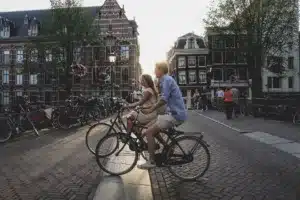
The Who Is Amsterdam cycling guide explains bike lanes, hand signals, junctions and the mistakes pedestrians make most often. The basic point is simpler: the bicycle lane is part of the road network, not extra pavement.
If you already cycle confidently in busy urban traffic, renting a bike can be useful.
If not, walk and use public transport. The centre is compact and declining to cycle is not a cultural failure.
Amsterdam does not require you to prove anything.
Expect Amsterdam To Cost More
In my experience, Amsterdam is about 20 to 30 percent more expensive than most German cities.
And don’t be surprised by the beer. We don’t drink from half-litre or litre glasses here, but from a vaasje: 250 ml. More than one German guest has looked at it and asked: oh, so this is your size of beer?
The Card-First Culture May Be the Most Practical Surprise
Amsterdam is comfortable with contactless payment.
Restaurants, cafés, museums and many market stalls take cards, and some businesses operate without cash altogether. The German Foreign Office currently notes that card payment is preferred in many parts of the Netherlands and can sometimes be the only payment method available.
The same applies to public transport.
For many visitors, OVpay is the easiest system: tap in with a compatible card, phone or smartwatch, then tap out using the same card or device.
The Amsterdam public transport guide explains trams, metro, trains, ferries and ticket options in more detail.
Carry a little cash if you like having a backup, but expect the opposite of Germany’s cash reflex: some Amsterdam businesses are card-only.
Coffeeshop Does Not Mean Café
A coffeeshop is a regulated cannabis establishment.
Dutch cannabis policy is based on tolerance under specific conditions rather than full legalisation. That distinction matters, especially for someone travelling back across an international border afterwards.
Do not take cannabis back to Germany.
If you want to understand how Amsterdam coffeeshops work before going inside one, the Who Is Amsterdam coffeeshop guide explains the system, etiquette, edibles and first-timer basics without treating cannabis culture like a circus.
Amsterdam tends to be more regulated than its international reputation suggests.
That is useful to remember in general.
Choose the Kind of Amsterdam Evening You Actually Want
German visitors don’t need Amsterdam to explain nightlife. And Amsterdam doesn’t need to compete with Berlin. It has its own nightlife identity.
Take electronic music. Berlin is famous for marathon nights in huge industrial spaces. Amsterdam’s scene is smaller and more compact, but it’s serious about its music. Every October the city hosts Amsterdam Dance Event, one of the biggest electronic music events in the world, and clubs in Noord, Oost and Nieuw-West keep that energy going all year.
And electronic is just one option. Paradiso and Melkweg cover major live shows; Bimhuis and Jazz Café Alto make jazz the plan; Mezrab and Tellers Playground build evenings around stories, spoken word, music and different cultural backgrounds. Add the brown cafés and the terraces, and a night out here doesn’t have to mean a pub or a club.
5. Traveling From Germany to Amsterdam Is the Easy Part
This is one of the biggest advantages for German visitors: you don’t need to fly, and you don’t need a car. The best way to get here is by train or by FlixBus.
Current NS International journey times put Amsterdam–Düsseldorf at around 2 hours 14 minutes, Cologne at around 2 hours 37 minutes, Frankfurt at roughly 3 hours 53 minutes and Berlin at around 5 hours 51 minutes on direct services.
And once you arrive at Amsterdam Centraal, you’re already in the city. You walk out of the station and Amsterdam is happening right in front of you. No car needed!
For current fares and engineering works, check NS International’s ICE timetable and booking information. Advance fares can be very affordable, but the price depends on the route, flexibility and when you book.
Thinking of Driving? Read This First
A lot of Germans think: let’s just take the car. I get it. But Amsterdam is really not a city made for cars.
Parking in the city centre costs €8.05 an hour at the time of writing, and a lot of German visitors are shocked when they find out. Yes, you pay for parking in Germany too, but not like this.
So if you do come by car, use a Park and Ride (P+R) on the edge of the city and take public transport in. Don’t park in the centre.
Bring Your ID
Schengen doesn’t mean no ID required. Bring a valid passport or Personalausweis. Your driving licence doesn’t count as a travel document.
6. How I’d Spend a Long Weekend in Amsterdam From Germany
I think 3 days in Amsterdam works extremely well for a first trip from Germany.
The important advantage is psychological.
Amsterdam is close enough that you do not need to behave as though this is the only weekend you will ever have here.
That gives you permission to do less.
Friday: Arrive, Make the City Click, Then Have a Borrel
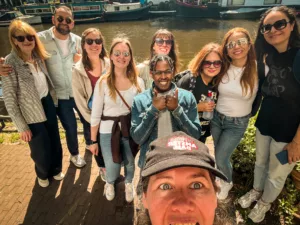
If you arrive in time, join the Hello Amsterdam Walking Tour. It runs on Fridays at 15:00, so it depends on your arrival time, but it’s the quickest way to make the city click.
You don’t need a guide for the whole weekend. You just need someone to make sense of the city once.
Once the walk finishes near Westerkerk, stay in the Jordaan and follow the smaller streets around Bloemgracht and Egelantiersgracht as the evening begins.
Then find a brown café and order a first round with something salty for the table.
A Dutch bruin café is not simply a Kneipe with different beer. The room may feel familiar; the borrel rhythm is distinctly Dutch.
Choose one that belongs to the neighbourhood you are already in.
Sit there long enough that choosing it begins to feel less like sightseeing.
Saturday: One Museum, De Pijp and an Amsterdam Night Out
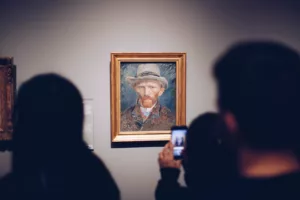
Book the Rijksmuseum or Van Gogh Museum for the morning. Afterwards, walk into De Pijp rather than adding another museum because it happens to be nearby.
Let Albert Cuyp Market become lunch, then slow down around Sarphatipark. In the evening, choose the Amsterdam you actually want: a neighbourhood terrace, live music at Paradiso or Melkweg, jazz at Bimhuis or Jazz Café Alto, storytelling at Mezrab or Tellers Playground, or electronic music and clubs.
Dinner is where I would try Indonesian or Surinamese food. If Berlin has taught you that a proper club night can start late, Amsterdam will not require an explanation; just do not mistake Leidseplein and Rembrandtplein for the whole scene.
The Ultimate Amsterdam Travel Guide is useful if you want extra museum, restaurant and neighbourhood ideas without rebuilding the entire itinerary around somebody else’s preferences.
Sunday: Slow Breakfast, One More Amsterdam, Then the Train Home
Keep Sunday flexible around your train. Have a slow breakfast, visit Noord or a neighbourhood market, and choose one final cultural stop rather than beginning another full sightseeing day.
Take the free ferry behind Centraal Station to Noord. EYE Filmmuseum sits right across the IJ, while NDSM takes you into a former shipyard landscape of large industrial buildings, creative spaces and street art.
Or use the day to understand the city more deeply.
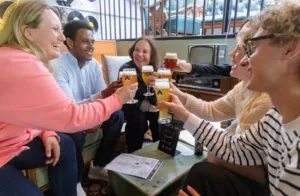
The Humans of Amsterdam Cultural Walking Tour connects the Jordaan, canal belt and old centre with conversations involving people whose lives relate to migration, activism, cannabis policy, sex work and entrepreneurship.
That type of experience makes more sense after you have already seen the basic city.
The first two days show you Amsterdam.
The third can start explaining why it became this version of Amsterdam.
If your trip is longer, the Who Is Amsterdam guide on how many days to spend in Amsterdam gives you a better idea of what an extra day or two can add.
Frequently Asked Questions
Yes. If you are covered by German statutory health insurance and have a valid European Health Insurance Card, it can be used for medically necessary state-provided healthcare during a temporary stay in the Netherlands under the applicable local conditions.
Usually not for a normal long-distance journey. The Deutschlandticket primarily covers local and regional public transport in Germany. Some cross-border regional services are included, but it is not generally valid on ICE, IC or EC services.
If you are planning to combine regional trains with the Deutschlandticket, check the exact route and ticket conditions before travel rather than assuming the border is where validity automatically stops or continues.
If your German passport or Personalausweis is lost or stolen, report the loss and contact the German consular authorities in the Netherlands for advice on replacement or emergency travel documents.
Germany has a Consulate General in Amsterdam, which is useful information to know before you need it rather than while standing in a hotel lobby searching through every pocket for the fourth time.
See Amsterdam At Your Own Pace
I first came to Amsterdam thinking I was visiting a neighbouring country. I didn’t realise I was discovering the place I’d eventually call home. And even after all these years, I still love how familiar and different the Netherlands can feel at the same time.
So come for a weekend. Walk the canals, try the bitterballen, eat Indonesian food, sit in a brown café and pay attention to the little cultural differences. And if you’d like a local to show you around, explore all Who Is Amsterdam tours.
You don’t have to see everything. Germany is just around the corner. You can always come back.
Who knows? You might fall in love with Amsterdam too.