
Tulips are the headline, but Dutch spring starts earlier, smells stronger and changes almost every week.
Written by Alexandra, Founder of Who Is Amsterdam
One of the questions people ask me before our spring tours is: “Will we definitely see tulips?”
Usually, yes – but Dutch spring is much more interesting than one perfect week of tulips. Depending on when you come, the entire landscape can look, smell and feel completely different.
A Dutch tulip tour sounds fairly easy. You go to the countryside. You see tulips. You take enough photographs to make your phone question its storage capacity.
Then you arrive in the Bulb Region and realise spring has been considerably busier than the name of the tour suggested.
Tulips are still the main event, obviously. But depending on when you visit, there may also be daffodils, hyacinths and the last crocuses in the commercial growing region. In designed spring gardens, muscari, fritillaria, irises, alliums, anemones and flowering trees can join the show as the season moves forward.
So the honest answer to “what flowers will you see on a Dutch tulip tour?” is that Dutch spring arrives in stages. The landscape you see in late March is not the same landscape you see three weeks later.
That is part of the fun.
1. What You See Depends on the Week You Visit
The most useful thing to understand before planning a tulip trip is that the landscape does not reach one perfect moment and stay there politely until everybody has finished their holiday.
Bloom moves. Weather can push it earlier or slow it down. Different crops flower at different times, and even tulip varieties have early, mid-season and late groups.
If tulips are genuinely one of the main reasons you are coming to the Netherlands, I generally recommend aiming for the second half of April. That gives you a strong chance of seeing plenty of tulip colour across the region – but nature does not work according to our calendar, and every year is slightly different.
Late March: The Transition
Crocuses and daffodils are important, hyacinths begin making themselves known, and early tulips start appearing. If you love the feeling of spring arriving rather than only the peak image, it can be a lovely time to go.
Early to Mid-April: The Overlap
This is where more flowers overlap. Daffodils may still be visible, hyacinths can be excellent, and increasing numbers of tulip fields begin filling in. The countryside often feels most obviously like a bulb-growing region at this point, rather than a landscape devoted entirely to one flower.
Mid to Late April: Tulip Territory
More commercial tulip fields are usually in colour, later cultivars come into bloom and the famous striped landscape becomes much easier to find across the region. If somebody asks me for the simplest timing recommendation for a tulip-focused trip, this is the window I usually point them towards.
Early May: Still Possible, but Less Predictable
Late tulips can still be excellent, especially in gardens with deliberately staggered planting, but individual commercial fields may already be topped or moving past peak. A field that was spectacular a few days earlier can suddenly be mostly green.
The calendar has an opinion.
The weather has another one.
This is also why I do not think about the flower part of our tour as a rigid list of fields. Different varieties peak at different moments, weather changes the timing, and farmers eventually start koppen – topping the flower heads as part of the growing cycle. We are not driving to a field simply because it looked beautiful in a photograph three weeks earlier.
On our Private Amsterdam Tulip & Windmill Tour, Tulip Experience gives the day a much more reliable tulip anchor, while the surrounding field stops can adapt to nature rather than pretending nature has read the itinerary. Then we head into the actual growing region and see what spring is doing on that particular day.
2. Tulips Are the Main Event, But “Tulip” Covers a Lot
When people imagine Dutch tulip fields, they tend to picture the classic cup-shaped flower repeated across a field in several colours. In reality, “tulip” covers a much stranger range of shapes than most people expect.
The varieties I enjoy showing guests are the ones that make people stop and say, “Wait, THAT is a tulip?” Double or peony-flowered tulips are packed with petals. Parrot tulips are twisted and theatrical. Fringed tulips look as though somebody has cut tiny crystals into the petal edges. Then there are the extremely dark burgundy and purple varieties that look almost black in the right light.
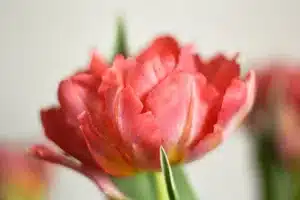
The Dutch flower-bulb organisation Flowerbulbs.com explains the main tulip groups here if you want to go deeper, but you do not need a botanical encyclopaedia to appreciate the difference once the flowers are standing beside one another.
Some cultivars even change noticeably as they mature. Tulip Experience describes its so-called “Magic Tulips” here, including varieties that shift from yellow towards orange or from white towards pink as the bloom develops.
That variety is one reason we begin the flower part of the day at Tulip Experience Amsterdam. Its show garden currently brings together around four million tulips across roughly 700 varieties, so it gives us a much more reliable tulip experience and makes it very obvious how broad the word “tulip” really is. Tulip Experience describes the current garden here.

After that, we move out into the commercial growing region. The contrast is useful: first you see extraordinary variety in a tulip-focused show garden, then you see what nature and farming are actually doing across the fields that week.
3. Daffodils Usually Get There Before the Tulips
Tulips receive almost all of the international marketing budget for Dutch spring, but daffodils are often already outside working when the tulips are still thinking about it.
The Bulb Region’s official flower guide places crocuses first, followed by daffodils in late March, then hyacinths and tulips as spring develops. You can follow the regional sequence through the official Duin- en Bollenstreek flower guide.
That means visitors arriving near the beginning of the season may find large patches of yellow before the classic tulip fields have reached their peak.
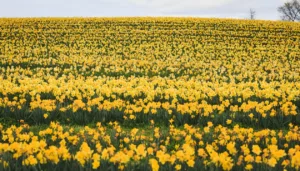
Commercial daffodil fields have a different mood from tulip fields. The yellow can be almost aggressively cheerful, but the flowers themselves look looser and less geometric.
Instead of the dense blocks people associate with tulip photographs, daffodils often give the landscape a softer first sign that winter has finally agreed to leave.
So if your dates are early, do not assume the countryside is “too soon” simply because every field is not full of tulips. Seeing the first bulb crops gives you a much better sense of how the season builds.
4. Hyacinths Are the Fields You Smell Before You Reach Them
Tulips win visually.
Hyacinths make a much stronger argument with your nose.
One of the coolest things about driving through the flower region when the hyacinths are blooming is that sometimes you smell the field before you properly see it. A flowering hyacinth field can announce itself before the road has given you a clear view.
The scent is sweet, heavy and unmistakable, especially when several rows are blooming together. It is also one of those details that photographs simply cannot communicate, and it makes being there feel completely different from looking at another perfect field on Instagram.
The hyacinth fields are part of the same Bollenstreek landscape that produces the famous tulips. The region’s sandy, well-drained soils are particularly suited to bulb cultivation, which is why crocuses, daffodils, hyacinths and tulips all became part of the agricultural landscape between Haarlem and Leiden. The regional tourism site has more background on the bulbs and flowers of the area.
Visually, hyacinths are easy to distinguish once you know what you are looking for. Instead of one larger cup-shaped flower, each stalk carries a dense cluster of small flowers.
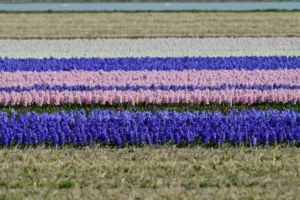
From a distance, a whole field can read as one low block of purple, pink, white or blue-toned colour.
They also have a shorter-feeling moment in the spring story. By the time many late-April visitors arrive specifically for tulip peak, some hyacinth fields may already be past their best.
Earlier April is often when the overlap becomes particularly good: tulips are beginning to become serious, hyacinths are adding scent and daffodils may still be hanging around.
You can drive the same road twice, ten days apart, and the dominant colour has changed.
The countryside did not redesign itself for your second visit.
It grew.
5. Commercial Fields, Tulip Experience and Keukenhof Show You Different Things
This is the distinction I would keep in mind when planning a Dutch spring trip: commercial fields, Tulip Experience and Keukenhof are not three versions of the same thing.
Commercial Fields = Agriculture
The fields across the Bollenstreek are working farms. You might see a block of tulips, another of hyacinths and another of daffodils because growers are producing bulb crops in separate lots. Many of the spectacular tulip fields are being grown for the bulbs rather than as cut flowers, which is also why the flower heads are eventually topped.
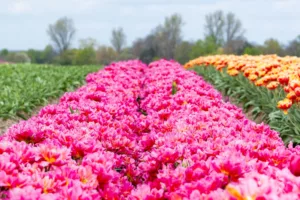
I would keep the farming explanation fairly simple here because our guide to why Dutch flower fields are planted in perfect stripes goes much deeper into the bulb lots, machinery, planting patterns and the reason those colour bands exist in the first place.
Tulip Experience = A Tulip-Focused Show Garden + Bulb-Farming Context
Tulip Experience is deliberately focused on tulips. The huge number of varieties in the show garden means we can usually show guests an enormous range of forms, colours and flowering stages in one place, while also connecting what they are seeing to the bulb-growing industry around them.
For our route, that makes it a very useful anchor. Out in the commercial fields, nature and farming decide what is happening. At Tulip Experience, the show garden gives us a far more reliable concentration of tulips before we head out to see what the wider landscape is doing that day.
Keukenhof = A Huge Designed Spring Garden
Keukenhof is doing something else again. It is a huge designed spring garden, built to layer many different flowers and planting combinations across the season rather than to look like a commercial bulb field.
Its displays can include crocuses, daffodils, hyacinths, early and late tulips, muscari, fritillaria, irises, alliums and other spring planting. The exact order changes with the weather, which is why Keukenhof publishes current flower reports during its opening season.
None of these is the “real” spring while another is the fake one. They are simply showing you different things: agriculture, tulip variety and a designed spring garden.
6. What I’d Pay Attention to on a Dutch Tulip Tour
Colour is the first thing you notice on a Dutch tulip tour. I would try not to let it be the only thing.
Look at the flower shapes when you are close enough. A classic single tulip and a double peony-style tulip barely look related once they open fully. Find a fringed one and inspect the petal edge. If there are parrot tulips, look at how irregular they become as the flower opens.
Notice the height differences. Notice how the fields sit beside villages, roads and farms. And when the hyacinths are out, open the car window and pay attention to the smell before you reach for your phone.
The main thing I would remember is that Dutch spring is not one frozen image of tulips at peak bloom. Crocuses begin it. Daffodils push the landscape into yellow. Hyacinths add blocks of colour and an absurd amount of scent. Tulips take over in more shapes and varieties than most people expect.
Come for the tulips. You probably should. But do not spend the whole day hunting for one perfect red field you saw on Instagram. Dutch spring changes constantly. Smell the hyacinths. Notice the daffodils. Look at the strange tulip varieties. Pay attention to the farms, villages and landscape around them.
That is where the experience becomes much more than a tulip photo.
It is also how we approach our Private Amsterdam Tulip & Windmill Tour: start with a reliable tulip-focused experience, then let the route through the growing region respond to what is actually blooming instead of forcing nature into a fixed itinerary.
Frequently Asked Questions
April is usually the strongest month overall. If tulips are one of the main reasons for your trip, I generally recommend aiming for the second half of April, when more commercial tulip fields are typically in colour. It is still only a rule of thumb: a cold or warm spring can move the season in either direction.
During the main spring season, tulips are usually easy to find, but I would be wary of anybody guaranteeing that one particular commercial field will look perfect on one particular date. Varieties peak at different times, weather changes the schedule and farmers top fields as the crop develops. That is exactly why our route uses Tulip Experience as a reliable anchor and keeps the surrounding field stops flexible.
Yes, you can. Late varieties and deliberately staggered garden displays can still be excellent in early May. The trade-off is that more commercial fields may already have been topped or may be moving past peak, so the countryside can be less consistently colourful than it is in the second half of April.
Commercial fields are working agricultural land, often growing bulbs in large single-variety blocks. Keukenhof is a designed spring garden using many flower species and planting combinations. Tulip Experience sits somewhere different again: it is a tulip-focused show garden with hundreds of varieties and a strong connection to bulb farming. They are complementary experiences, not “real” versus “fake” versions of Dutch spring.
Many Dutch commercial tulip fields are grown primarily for the bulbs rather than for cut flowers. Growers may remove the flower heads in a process known as topping so the plant can direct more energy towards the bulb below ground. If you want the deeper farming explanation, our article on why Dutch flower fields are planted in perfect stripes explains how the production system works.
Not quite. Some tulips are extremely dark burgundy or purple and can look black in certain light, but there is no naturally true black tulip. The same goes for true blue. Flowerbulbs.com explains the tulip colour range and classifications here.