
A local guide to the royal birthday and orange logistical experiment.
Written by Alexandra, Founder of Who Is Amsterdam
I grew up in Germany, which doesn’t have a monarchy. So my first King’s Day went something like this: why is everyone so into the monarchy? Not even loving it, just… what’s the hype here?
Then I saw it. And I was in awe.
My idea of a monarchy came mostly from what I’d picked up about the British royals here and there, and the Dutch monarchy is a whole different ball game. The Dutch royals come across as much closer to the people. Approachable. Always in for a joke.
That is King’s Day in Amsterdam.
The next King’s day celebration falls on Tuesday, 27 April 2027, with King’s Night on Monday, 26 April. Amsterdam has confirmed those dates, although the detailed transport plans, boating restrictions and crowd measures for 2027 will be published closer to the celebration. (City of Amsterdam)
This guide will explain the parts that make King’s Day what it is, while being clear about anything visitors need to check again before 27 April 2027.
What Is King’s Day In Amsterdam, Really?

The straightforward answer to what is King’s Day in Amsterdam is that it is the Dutch national holiday celebrating King Willem-Alexander’s birthday.
In other words: the head of the monarchy throws a really huge birthday party, and the whole country is invited.
His birthday is 27 April, and that is when the Netherlands normally celebrates Koningsdag. The Dutch government lists Tuesday, 27 April 2027 as the next official King’s Day.
The Amsterdam version is harder to summarise. Calling it a royal celebration makes me imagine flags, speeches and people standing politely behind barriers.
There is some royal symbolism, obviously.
King’s Day belongs to the monarchy historically, but the streets belong to everyone else for most of the day. That is why Koningsdag Amsterdam feels different from a conventional national celebration.
People start early.
The vrijmarkt spreads through neighbourhoods.
Families set up pavement stalls.
There are organised festivals, street celebrations and neighbourhood parties. The canals become a moving part of the event, with boats full of friends travelling through a city already crowded on land.
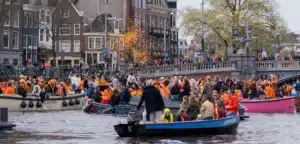
Orange is the royal family’s colour, and over time it became the colour of the whole country. It is why Dutch supporters turn orange during international football and why King’s Day can make Amsterdam look as though somebody adjusted the saturation settings overnight.
You do not have to wear orange, though. But if you own something orange, this is the day it has been waiting for.
And pay attention to the date when you book. Every year I meet visitors who came at the end of April, often for tulip season, who suddenly look around like: what is happening? Nobody told them about King’s Day. Some museums open, but a lot of shops and businesses close, and normal sightseeing more or less stops for the day.
So if you’re here on 27 April, there’s really only one thing to do: party with us.
King’s Day itself is the activity.
Why the Vrijmarkt Matters More Than It Looks
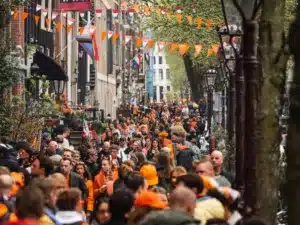
If I had to choose one part of King’s Day that tells you something about Dutch culture, I would not start with the enormous parties.
I would start with someone selling their old toaster.
The vrijmarkt literally means “free market”, and that’s exactly what it is. For one day, anyone can sell whatever they want on the street. No permit, no market fee. You can just do your thing.
Now say that to the country that gave the world its first stock exchange. It goes wild. And honestly, it’s really cute. Streets and parks fill up with blankets, folding tables and improvised stalls.
For the visitor searching for a King’s Day flea market Amsterdam, this is the part they mean. But “flea market” makes it sound more organised than it often is.
You may find vintage clothes, books, toys and records. You may also find one shoe.
A remote control. A bowl somebody has owned since 1997. An object nobody involved can identify.
The charm is partly that this is not a curated vintage market arranged for visitors.
Families clear cupboards.
Children sell old toys.
Teenagers try their first business model.
Neighbours occupy pieces of pavement they normally walk past.
In recent editions, Amsterdam’s citywide vrijmarkt has officially run from early morning until the evening. The latest published practical guidance listed 06:00 to 20:00, although the city will confirm the exact 2027 arrangements closer to the date.
Vondelpark and the Children’s Vrijmarkt
Vondelpark has its own tradition.
The park is associated with a children’s vrijmarkt, where younger Amsterdammers sell toys, perform, organise small games and discover that capitalism is much more exciting when the startup costs involve a blanket from home.
There are rules.
Recent regulations have prohibited alcohol sales from vrijmarkt stalls and restricted the sale of perishable foods such as meat, fish and dairy products unless the seller has the proper licence. The exact rules should be checked again for 2027 before anyone begins an ambitious street-side bitterballen operation.
I like the vrijmarkt because it gives the morning a completely different character from the afternoon.
Later, King’s Day becomes louder.
Earlier, it can feel local.
Parents are setting up stalls. Children are negotiating prices with adults who absolutely do not need another stuffed animal. People walk slowly because there is something to look at every few metres.
And it’s not just the market. People cook outside, there’s music everywhere, and because parties are allowed, people open up their houses or a DJ plays out of a front window, so you end up dancing on the pavement for a song or two. Kids invent all kinds of games and rope you in. You walk a little, you eat, you play, and then maybe you hop on a boat.
One tip if you’re hunting for bargains: get up early. Locals really do. The best finds are gone long before lunch.
If your idea of King’s Day is only crowds and beer, go out early.
If markets are something you enjoy even when the entire country is not wearing orange, our guide to Amsterdam’s best food markets covers Albert Cuyp, Dappermarkt, Noordermarkt and other places where markets are part of normal city life rather than a once-a-year takeover.
King’s Night, Canal Boats And The Part That Gets Chaotic
King’s Day has an opening act.
King’s Night Amsterdam happens on 26 April, the evening before the national holiday.
For 2027, Amsterdam has confirmed King’s Night for Monday, 26 April, followed by King’s Day on Tuesday. Detailed event programmes will appear closer to the date.
The city begins shifting mood before anyone wakes up for the vrijmarkt. There are also ticketed events and nightlife programmes across Amsterdam. And then people who stayed out for King’s Night discover that King’s Day has the slightly inconvenient habit of beginning the following morning.
Choose your commitment level wisely. You do not receive an additional public holiday for recovery.
The other famous part of the celebration happens on the water.
The King’s Day Amsterdam canals image is one of the reasons the event looks so spectacular online: boats packed with people in orange moving through narrow waterways while thousands more watch from bridges and canal edges.
For 2026, Amsterdam enforced specific navigation rules including a maximum of 12 passengers plus the skipper per boat, speed restrictions and a ban on drinking alcohol while operating the vessel. The canals are described by the city’s visitor organisation as extremely busy during the celebration. Those details show why visitors should wait for the official 2027 navigation rules before arranging a boat.
It’s also one of the very few days a year when you can party on the canals. Normally you can’t just rent a boat and turn it into a party. On King’s Day you can, and the only other time the canals look like this is Pride.
If you want to be out on the water yourself, look online for an organised boat party with its own skipper rather than steering a rental boat through that traffic. Being on the canals that day is something special. And watching from a bridge is great too: you get the boats without being responsible for one.
For normal Amsterdam travel, our public transport guide explains trams, metros, ferries and OVpay.
On King’s Day, check the official GVB and city updates again.
Normal Amsterdam transport knowledge remains useful.
Normal Amsterdam expectations do not.
How I’d Actually Spend King’s Day In Amsterdam
My honest advice: start early.
Walk through the city in the morning. The city centre and the Jordaan are wonderful before lunch, when the vrijmarkt is in full swing and the streets still feel like a neighbourhood party.
The later it gets, the more crowded it gets, and the more drunk people get. If that’s your thing, great, the party is waiting for you. If it isn’t, you’ve already had the best part of the day.
There’s a lot more going on, too. There are festivals and big organised parties that people plan for weeks, so the whole city is very, very full.
1. Start With the Vrijmarkt
I would begin with the vrijmarkt in the morning, especially if it is your first King’s Day.
You can walk while the city is still building towards the larger afternoon crowds and see the side of the celebration that feels more like neighbourhood life than a giant party.
Then I would eat.
Earlier than I think I need to.
King’s Day has a way of turning “we’ll grab something later” into five hungry people standing behind seventy other hungry people.
After that, walk.
Comfortable shoes matter more than a clever route. On recent King’s Days, road closures, rerouted transport and dense crowds have made ordinary journeys much slower, so central Amsterdam is often easiest to navigate on foot.
Official 2027 details are still to come, so check the City of Amsterdam King’s Day page shortly before your trip.
2. Dress for Amsterdam, Not Only for the Photos
Then there is the question people start searching with increasing urgency as April approaches: what to wear on King’s Day Amsterdam.
Orange helps you join the mood.
No orange in your suitcase? No problem. In the weeks before, shops all over town sell orange, and on the day itself you can buy orange everything on almost every corner.
Comfortable layers help you enjoy it for more than an hour.
Amsterdam in late April can give you sunshine, wind and rain without feeling obliged to choose one. Bring something waterproof and wear shoes you are willing to walk in for hours.
Do not construct an elaborate orange outfit that becomes physically unbearable by lunchtime.
This is a public holiday, not an endurance-based costume competition.
I would also carry as little as possible: a phone, payment card, some cash for informal vrijmarkt sellers, water and a compact rain layer.
For 2026, Amsterdam introduced restrictions around alcohol carried on the street and reinforced rules around glass because of the size of the crowds. Those details can change, so check the 2027 rules rather than relying on what somebody got away with a few years ago.
3. You Don’t Need the Busiest Street
I would not spend the whole day trying to reach whichever part of Amsterdam looks most crowded on Instagram.
The centre and Jordaan can become intensely busy. In recent official guidance, families with children were specifically advised to avoid some of the busiest parts of Jordaan.
Amsterdam has neighbourhood celebrations for a reason.
Oost has a long tradition of local King’s Day activity around areas such as the Bredeweg. In 2026, for example, the Bredewegfestival combined King’s Night and King’s Day with music, theatre and neighbourhood events.
Programming changes every year, but the point remains: Koningsdag exists well beyond the central party streets.
Sometimes moving slightly away from the biggest crowd gives you more of the day rather than less of it.
4. Save Normal Amsterdam for Another Day
If your trip includes time before or after King’s Day, use it. That is when I would do the museums properly.
Walk the canal belt when you can hear the canal. Go into the Jordaan when you can actually see the Jordaan.
And if you want some context before Amsterdam temporarily changes shape, take the Hello Amsterdam Walking Tour before the holiday. Our two-hour introduction covers the city’s history, canal belt, Dutch culture and everyday life.
The Ultimate Amsterdam Travel Guide is useful too if King’s Day is only one part of a longer spring trip.
King’s Day deserves the day.
Amsterdam deserves another one.
What King’s Day Tells You About Amsterdam
The strange part about one of the Netherlands’ biggest royal celebrations is how unroyal much of it feels.
But the actual experience belongs to neighbourhoods, families, children, friends, bar owners, boat owners, market sellers and everybody trying to locate everybody else in an overcrowded city.
That tells you something.
Dutch culture has a practical streak even when celebrating. The country marks the King’s birthday by giving ordinary people an unusual amount of ownership over public space.
Then Amsterdam adds its own geography. And because this is Amsterdam, freedom comes with an impressive quantity of regulation.
Maybe that is why King’s Day Amsterdam works.
It is not polished enough to feel like a festival produced for visitors. Parts of it are organised, parts are commercial, and the city has to manage huge crowds.
But underneath all of that is a tradition people participate in themselves.
They put the table outside. They dress the children in orange. They invite friends onto the boat. They make plans that fall apart by 13:00 and continue anyway.
For one day, Amsterdam becomes harder to move through and easier to understand.
If you pay attention, the orange is the least interesting part.
So come prepared. Come open-minded, ready to party, ready to play. And have a really fun day.
Frequently Asked Questions
Some are, some are not. In recent years, major attractions including the Rijksmuseum, Van Gogh Museum, Stedelijk Museum and Anne Frank House have traditionally remained open, while other cultural institutions close for the holiday. Opening hours can change each year, so check the venue’s own website before buying tickets.
No. King’s Day is an official Dutch public holiday, but Dutch law does not automatically give every employee the right to a day off on public holidays. Whether someone works depends on their collective labour agreement or employment contract. So the streets may look as though the entire country called in sick together.
Yes. You can browse and buy from the informal stalls the same way anyone else can. Payment depends on the seller. Dutch residents may use local payment apps between themselves, so international visitors who want to buy small second-hand items may find a little cash useful. Do not arrive expecting professional market infrastructure.
Yes. King’s Day is a national Dutch holiday, not an Amsterdam-only festival. Cities and towns across the Netherlands hold their own markets, parties and local celebrations, while the Royal Family traditionally visits a selected municipality for an official programme. The Amsterdam version is especially large because of the city’s density, nightlife and canals.
See Amsterdam Beyond King’s Day
King’s Day shows you Amsterdam at its loudest. Give yourself another day to meet the city at normal volume.
Start with our Hello Amsterdam Walking Tour for the history and context behind the streets, go deeper into the people and culture on the Humans of Amsterdam Cultural Walking Tour, or explore the city through food on our Jordaan Food Tour and De Pijp Food Tour.
You can also see all Who Is Amsterdam tours and choose the one that fits the rest of your stay.