
A tulip field can look like one block of colour. Get close, and the flowers start disagreeing about what a tulip is supposed to look like.
Written by Alexandra, Founder of Who Is Amsterdam
I’ll be honest. The first time I went to see the tulip fields in Amsterdam, I thought: oh God, what’s the big deal? They’re flowers.
Then I saw them. Early in the morning, when the air is still brisk, or at sunset, when the light goes soft. It was breathtaking. One of those moments where you look at something, your head goes quiet, and you’re just instantly happy.
At home, a bunch of tulips on the table makes a room feel cosy. Here, they come in their thousands. It’s mesmerising.
On our tulip tours in Amsterdam, I see the same thing happen again and again. Some guests have planned this trip for years. It’s on their bucket list, and they’ve spent weeks praying for good weather. Then they step out of the car, see the fields, and you can see it in their eyes. People are genuinely moved. And then, of course, out come the cameras.
Yes, there’s a whole story behind the tulip, and I love telling it. But in the end, this is about taking in nature at its very best.
The first Dutch tulip field you see from a distance can feel almost too simple.
Red stripe. Yellow stripe. Pink stripe. Done.
Then you get close to the flowers.
Some have the neat cup shape everyone recognises immediately. Others have pointed petals that flare out like lilies.
Some are fringed around the edges. Some are so full of petals they look like peonies. Parrot tulips curl and twist. Viridiflora tulips carry green through the petals.
Coronet tulips appear to have folded themselves into little crowns.
This is where the phrase 12 types of tulips becomes more useful than it sounds.
There are thousands of named cultivars in cultivation, and tulips are also organised into horticultural groups according to things such as flower shape, parentage and flowering period.
The exact classification system has changed as breeders produce new forms, so this is not a complete botanical catalogue.
It is the visitor version: twelve types distinctive enough that you can start recognising them while walking through a show garden or looking closely at the flowers during tulip season in the Netherlands.
At Tulip Experience Amsterdam, the show garden currently contains around 700 varieties. Keukenhof says it uses roughly 800 tulip varieties among the millions of bulbs planted in the park each year. That is far more than anyone needs to memorise before breakfast.
Twelve is manageable.
And once you know the shapes, a Dutch tulip garden becomes much more interesting than rows of colour.
Before You Start Counting: Type and Variety of Tulips Are Not the Same Thing
Tulip names can become confusing very quickly because a type is not the same thing as a variety or cultivar.
Think of the type as the larger family resemblance.
Triumph tulips form one group. Darwin Hybrids form another. Parrot tulips have their own recognisable shape. Inside each of those groups are individual cultivars with names such as ‘Negrita’, ‘Pink Impression’, ‘Queen of Night’ or ‘Apricot Parrot’.
The Royal Horticultural Society still uses the long-established horticultural group system for tulips, while the Dutch Royal General Bulb Growers’ Association, KAVB, continues to refine classification as breeding changes the flowers available. KAVB even created a newer Coronet Group after cultivars with a distinctive crown-like flower shape no longer fitted comfortably into older categories.
Its explanation of the Coronet Group is a nice reminder that tulip classification is not a museum exhibit. Breeders keep making the problem more interesting.
For visitors, the easiest way to understand types of tulips in the Netherlands is visually.
What shape is the flower?
How many petals does it appear to have?
Does it bloom low to the ground or high above the leaves?
Are the petal edges smooth, pointed, fringed or twisted?
That is enough to begin.

If you want the broader spring picture first, our Ultimate Amsterdam Travel Guide explains how tulip season fits into a longer Amsterdam trip. For the countryside itself, our Private Amsterdam Tulip & Windmill Tour by Car includes Tulip Experience and the surrounding flower-growing region, which gives you the useful combination of a show garden up close and commercial fields from the road.
The difference matters because the widest variety of flower shapes is much easier to study in a show garden than in a working field growing one commercial crop in large blocks.
The Classic Tulips You Will Recognise First
1. Single Early Tulips
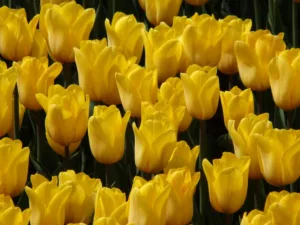
Single Early tulips are close to the tulip most people have in their head before they begin learning names.
One flower sits on a relatively short, sturdy stem with a clean, uncomplicated cup shape. They bloom towards the beginning of the tulip season, and the flowers often look compact compared with the taller late-season groups.
The Dutch flower-bulb industry describes Single Earlies as early flowering, generally around 20 to 30 centimetres tall, with sturdy flowers suited to pots, beds and forcing. Familiar cultivars include ‘Apricot Beauty’ and ‘Prinses Irene’. Flowerbulbs.com’s Single Early overview gives the longer cultivar list.
They are useful as your baseline.
Once you know what a straightforward Single Early looks like, the strange ones become much easier to spot.
2. Triumph Tulips
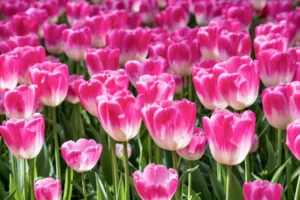
If somebody asked me to draw the most recognisable commercial tulip, I would probably end up somewhere near a Triumph.
Triumphs have sturdy stems and a classic flower shape, and they come in an enormous range of colours. They were developed by crossing Single Early and Single Late tulips and became one of the most important commercial tulip groups.
Flowerbulbs.com describes Triumphs as a major group valued for strong stems, good flower form and a broad colour range.
This makes them especially relevant when you are looking across Dutch tulip fields.
A commercial field is not trying to show you twelve flower forms in one place. It is producing bulbs efficiently.
Strong, uniform plants with reliable colour have obvious advantages to growers, which is part of why the classic tulip shape remains so common in the landscape.
Up close, though, Triumph cultivars can vary much more than the field suggests. Some are rounded.
Some are longer.
Some have clean single colours; others carry contrasting edges or flames.
The stripe looked simple from the road.
It was hiding details.
3. Darwin Hybrid Tulips
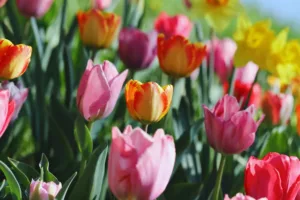
Darwin Hybrids are the tulips that make a Single Early look as though it has been going to the gym. They are tall, sturdy and known for large goblet-shaped flowers.
Many cultivars sit around 50 to 60 centimetres high, and the group has a reputation for strong stems and bold colour.
The Dutch bulb industry traces the development of Darwin Hybrids to breeder D.W. Lefeber, who crossed Fosteriana tulips with the older Darwin tulips in the Netherlands.
The Flowerbulbs Darwin Hybrid guide explains that breeding history.
The RHS describes modern Darwin Hybrids as large-flowered, sturdy and weather resistant. Recent trial selections include cultivars such as ‘Pink Impression’, ‘Golden Apeldoorn’ and ‘Red Impression’. (RHS Darwin Hybrid trial)
These are tulips with presence.
If the field looks particularly tall and the flowers feel almost oversized in relation to the stems, Darwin Hybrid is a useful possibility to have in mind.
4. Single Late Tulips
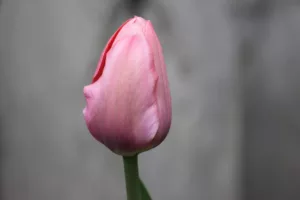
Single Late tulips keep the classic single flower but stretch the season and often the height. They tend to bloom later, frequently in May, and many are among the tallest garden tulips.
Their flowers can be elegant and egg-shaped, with a wider range of colours and forms than the phrase “single late” makes sound remotely exciting.
One of the best-known examples is ‘Queen of Night’, whose deep purple colour can appear almost black in certain light.
The RHS included it in its 2026 late-tulip trial alongside other Single Late cultivars, noting the group’s tall stems and late-season impact. The full RHS trial is worth a look if you enjoy cultivar names more than is strictly necessary.
Single Late tulips are useful for understanding why the Dutch spring does not have one exact peak moment.
Different groups take turns.
By the time early tulips are finished, later ones are still arriving.
The Tulips That Look as Though Someone Added More Petals
5. Double Early Tulips
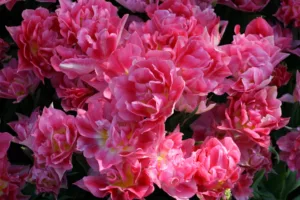
Double Early tulips are where the clean tulip silhouette begins becoming less reliable.
They flower early but carry many more petals than a classic single tulip, producing a fuller, layered bloom on relatively short stems. When fully open, some can reach around 7.5 to 10 centimetres across.
The Dutch bulb-industry guide to Double Early tulips describes the group as short, sturdy and particularly useful for beds and containers.
If a normal tulip looks like a cup, a Double Early looks as though somebody kept adding petals after the cup was finished.
The effect is lush without becoming enormous.
These are especially fun to compare with Double Late tulips because both groups can look peony-like, but the timing and proportions are different.
6. Double Late Tulips
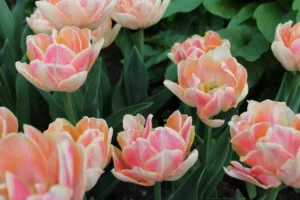
Double Late tulips have fully committed to the peony impression.
The flowers are large, densely layered and often heavy enough that a strong spring shower can make them look slightly offended afterwards.
The RHS describes Double Lates as lush, layered flowers that frequently resemble peonies, which is why you will also hear them called peony-flowered tulips.
They bloom towards the end of the season. RHS’s 2025 Double Late trial compared dozens of these cultivars alongside Parrot and Coronet tulips.
At Tulip Experience, double tulips are described as a visitor favourite, and it is easy to understand why. They barely look like the flower on the Dutch tourism poster anymore. (Tulip Experience on unusual varieties)
They are one of the easiest Dutch tulip varieties to recognise once the bloom has fully opened.
Look for volume. Lots of it.
The Tulips That Start Playing With Shape
7. Lily-Flowered Tulips
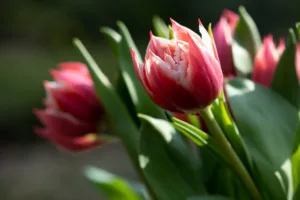
Lily-flowered tulips are elegant in a way that makes ordinary tulips look slightly blunt.
The petals are long and narrow, tapering into points that curve outward as the flower opens. The shape creates a star-like or fluted effect rather than a rounded cup.
The RHS describes them as having narrow flowers with pointed petals that reflex outward at the tips. Its Lily and Fringed tulip trial includes classics such as ‘White Triumphator’, ‘Ballerina’ and ‘Marilyn’ alongside newer cultivars.
These are late-spring flowers, so they are more likely to appear once the season is properly underway.
From a distance, a Lily-flowered bed can still read as a block of colour.
Up close, the tips give them away immediately.
8. Fringed Tulips
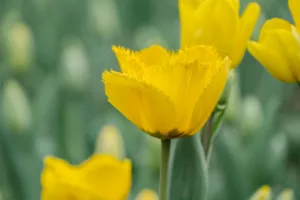
Fringed tulips look as though frost has caught the edge of every petal and decided to stay there. The fringe can be delicate and almost feathery or dense enough to look prickly.
Sometimes it matches the main flower colour; sometimes it creates a contrasting edge. The RHS notes that the finely cut borders can range from a flat fringe to thicker clustered structures that create a noticeably textured flower. (RHS Fringed tulip trial)
They are the kind of flower you need to see close up. A whole field of red looks red.
One fringed petal suddenly gives you something else to photograph. Among unusual tulips, this group is one of the easiest to recognise without knowing a single cultivar name.
9. Viridiflora Tulips
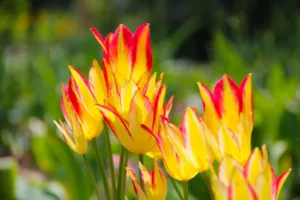
Viridiflora tulips carry green through the petals even when the rest of the flower is pink, white, yellow or another colour.
That green is not an accident or a sign that the flower forgot to finish. It is the defining feature of the group. The RHS describes Viridiflora tulips as having distinctive green-flamed petals that remain visible as the flowers mature.
Cultivars such as ‘Spring Green’, ‘Artist’ and ‘Virichic’ show how different the effect can look depending on the second colour. (RHS Viridiflora trial)
These are slower-burn flowers.
Parrot tulips shout from across the path. Viridiflora tends to become interesting once you are already standing beside it.
Look for the green brushstroke running vertically through the petal. Once you see it, you will begin finding it everywhere.
10. Parrot Tulips
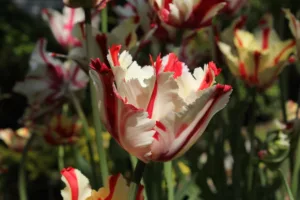
Parrot tulips appear to have ignored several instructions during development.
The petals twist, curl, ripple and split into irregular edges.
Colours can be equally dramatic, with streaks, contrasting tones and petals that open so widely in sunshine the flower can become almost saucer-shaped.
The RHS describes Parrot tulips as flamboyant flowers with feather-like, twisted and curled petals. Its 2025 trial included cultivars such as ‘Apricot Parrot’, ‘Black Parrot’ and ‘Flaming Parrot’. (RHS Parrot tulip trial)
This is the tulip for people who thought tulips were too tidy.
There is very little tidy left.
If you visit a show garden during a Dutch tulip tour, these are worth actively looking for because the details disappear quickly when you are staring across a large production field.
11. Greigii Tulips
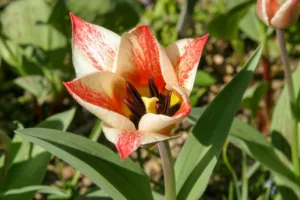
Greigii tulips are useful because the leaves are almost as distinctive as the flowers.
They tend to be short, early-flowering plants with relatively large flowers for their height, but the foliage often carries purple or brown stripes, spots or mottling.
That makes them recognisable even before the flower has fully taken over the scene.
Flowerbulbs.com’s Greigii guide notes the striped and spotted foliage as one of the group’s defining features.
‘Red Riding Hood’ is among the best-known cultivars.
These are more likely to catch your attention in a designed garden, rockery or close-up planting than in a vast commercial block.
That difference is useful to remember when people talk about tulip varieties in the Netherlands as though every cultivar should appear in a roadside field.
Working farms and visitor gardens are showing you completely different versions of tulip growing.
12. Coronet Tulips
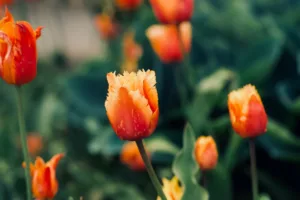
Coronet tulips are a good place to end because they prove the classification story is still moving.
Their petals are laterally compressed and develop a small spout or folded point at the top, giving the open flower a crown-like shape.
KAVB created the Coronet Group after an increasing number of cultivars with this unusual form no longer fitted comfortably into older categories. Its reference cultivar is ‘Picture’, and later examples include names such as ‘Crown of Dynasty’ and ‘Elegant Crown’. (KAVB Coronet Group)
That is one of my favourite things about learning flower types. The garden does not change at all.
Your eyes do.
Where You Will Actually See the Widest Range
Here’s the thing most people only realise once they’re standing next to one: a tulip field is a farm, not a garden.
The fields in the Bulb Region, between Lisse, Hillegom and Noordwijkerhout, and the large ones further north in North Holland, are there to grow bulbs. Each block is usually one variety, planted in long straight rows so it can be checked and harvested efficiently. That’s where the famous stripes come from, and why from the road you’ll mostly see the classic Triumph and Darwin Hybrid shapes.
One more thing about those fields: they’re private land. Enjoy them from the edge and don’t walk in for the photo. The farmers have seen that photo. Many, many times.
If you want to tick off all twelve types, you need a show garden.
Tulip Experience Amsterdam, near Lisse, has around 700 varieties in its show garden, right next to working fields. You get the close-ups and the stripes in one stop.
Keukenhof, also in Lisse, plants roughly 800 tulip varieties and does it beautifully. It’s also where everyone else is going, so go early or late in the day.
Hortus Bulborum in Limmen is the quiet one: a small heritage garden that keeps historic tulip varieties alive, some of them centuries old. Ideal if you’re more curious about where tulips came from than about the perfect photo.
Timing matters as much as place. The early types (Single Early, Double Early and Greigii) usually flower from late March into mid-April. The late ones (Single Late, Double Late, Parrot, Lily-flowered and Viridiflora) carry on into late April and May. Mid to late April usually gives you the best chance of seeing the most types at once, but the weather decides, and every spring is a little different. Our month-by-month guide to the best time to visit Amsterdam helps you plan around it.
We don’t take our guests to Keukenhof. It’s beautiful, but it’s super crowded. Instead, our Private Tulip & Windmill Tour by Car goes to Tulip Experience Amsterdam. They grow all sorts of tulips there too, and each one is explained. It’s run by real tulip farmers, you can buy tulips to take home, and it’s calm rather than crowded. We go early in the morning, and then head out to the fields as well, so you get the best of both worlds: the show garden up close and the stripes from the road. After that it’s the countryside: the village of De Rijp and the museum windmill at Schermerhorn, where you can step inside a real mill. Your guide and driver collect you from your hotel, and the tour runs from the last week of March to the first week of May.
How I Look at Amsterdam Tulips Now That I Know the Types
Fair warning: once you know the twelve types, you can’t un-know them.
Start far away, then walk in. Look at the field or the flower bed as a block of colour first. Then pick one flower and get close. That switch from stripe to single flower is the whole fun of it.
Look at the shape before the colour. Is it a cup, a goblet, a star, a peony, a little crown, or complete chaos? Colour tells you the variety. Shape tells you the type.
Check the leaves. Stripes or purple spots on the leaves mean Greigii, often before the flower has even opened.
Notice the height. Short and early is usually a Single or Double Early. Tall and stately points to a Darwin Hybrid or a Single Late.
And if you can, go back a week later. Different groups take turns, so the same garden can look completely different from one week to the next.
My own favourite? I might be boring, but I just love the classic tulip. I grew up with them, my mum loved them, and I still buy them all the time. Beautiful flowers at such an accessible price is one of the real perks of living in the Netherlands.
If you’re the person who comes home with 300 photos (no judgement, I’m one of them), the Fringed and Parrot tulips give you the best close-ups. For the city side of your trip, here are the most photogenic spots in Amsterdam.
Want to see the twelve for yourself? Join our Private Tulip & Windmill Tour by Car: show garden, flower fields and windmill country in a single morning, with a local guide who’ll happily point out every Parrot tulip on the way.