
From herring and bitterballen to poffertjes and apple pie: the Dutch snacks a local actually eats, and where to find them.
Written by Alexandra, Founder of Who Is Amsterdam
When I moved to Amsterdam from Hamburg, I thought I knew what to expect from Dutch food.
Then someone put a plate of bitterballen in front of me.
Oh man. I fell in love. Crispy on the outside, hot and creamy inside, dipped in mustard, with a cold drink in a brown café. I’ve travelled quite a bit, and I honestly believe the Dutch are leading the world when it comes to bar snacks.
Dutch cuisine doesn’t always get the credit it deserves. But Dutch snacks? That’s where this country really shines.
Here’s my guide to the Dutch snacks and street food worth trying in Amsterdam: the ones I love, the ones guests ask me about most, and where to find them.
The Dutch Kitchen vs Dutch Snacks
Let’s be honest. The Dutch kitchen is not world cuisine. Absolutely not.
Nobody flies to Amsterdam for a traditional Dutch dinner. Classic Dutch home cooking is famously simple: potatoes, meat and vegetables on one plate. There’s even an abbreviation for it: AVG, short for aardappelen, vlees, groente. In winter, we mash it all together and call it stamppot. And lunch? Often a cheese sandwich, eaten at your desk in ten minutes.
Simple. Practical. Efficient. Very Dutch.
But snacks? That’s a completely different story.
When it comes to frying, the Dutch are on another level. I would even argue that we have some of the best snack bars in the world. Bitterballen, kaasstengels, kaassoufflés, kroketten, frikandellen… So good. So, so good.
And here’s a fun fact that sums it all up: the air fryer was invented by a Dutchman. Fred van der Weij wanted crispy fries without a pan full of oil, built a prototype, and Philips launched the Airfryer in 2010.
Of course it was a Dutch invention. A simple, practical machine to make fried snacks even easier. If that isn’t the Dutch kitchen in one sentence, I don’t know what is.
So no, we won’t win any Michelin stars with our grandmothers’ recipes. But give us a deep fryer, a snack bar and five o’clock on a Friday, and we’ll show you what we’re really good at.
The Dutch snacks you should know
| Snack | What it is | Where to try it |
| Herring (haring) | Mildly salted raw herring with onions and pickles | Herring stalls and markets |
| Bitterballen | Small deep-fried balls of meat ragout, with mustard | Brown cafés, at borrel time |
| Kroket | Larger ragout croquette, often on bread | Snack bars, FEBO |
| Fries (patat or friet) | Thick-cut fries, usually with mayonnaise | Snack bars and fries shops |
| Kibbeling | Battered, fried chunks of white fish | Fish stalls and markets |
| Poffertjes | Mini puffy pancakes with butter and powdered sugar | Markets, fairs and poffertjes stalls |
| Apple pie (appeltaart) | Deep apple pie with cinnamon, served with whipped cream | Cafés and brown cafés |
| Stroopwafel | Thin waffles with caramel syrup in between | Markets, fresh off the iron |
| Oliebollen | Deep-fried dough balls with powdered sugar | Seasonal stalls, roughly November to New Year |
| Satay (saté) | Indonesian grilled skewers with peanut sauce | Markets, snack bars and Indonesian restaurants |
The Savoury Classics
Herring: Yes, I’m a Sucker for It
Let’s start with the one that scares visitors the most.
I love herring. I’m a real sucker for it.
Dutch herring (haring) is raw, mildly salted fish. It’s soft, fresh and not at all as “fishy” as people fear. The most famous version is Hollandse Nieuwe: the new season’s herring, which usually arrives in the shops in June, when the fish have built up enough fat to be at their best.
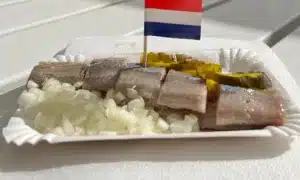
Now, about how to eat it.
You’ve probably seen pictures of people holding a herring by the tail, tilting their head back and lowering it into their mouth. That’s the traditional way, and I’ve done it a couple of times, just for fun.
But I eat it the Amsterdam way: cut into pieces, served on a little paper tray with chopped onions and pickles, and eaten piece by piece with a small cocktail stick. When you live here and want to get on with your day, that’s simply less hassle.
You can also order a broodje haring: herring in a soft white roll with onions and pickles. A perfect first try if you’re a bit nervous.
Bitterballen: The Best Bar Snack in the World?
Bitterballen surprised me even more than poffertjes. So good. So, so good.
They are small, round, deep-fried balls filled with a thick, creamy meat ragout. You dip them in mustard and eat them while they’re piping hot. Careful with the first bite: the inside is like lava.
The name comes from the bitter, a herbal liqueur they were traditionally served with. Today you’ll mostly see them with a beer or a glass of wine.
Bitterballen are one of the snacks guests ask me about most on my tours. My answer is always the same: order them in a brown café, around five o’clock, with a drink. That’s exactly how they’re meant to be eaten.
Kroket and the Famous FEBO Wall
The kroket is the bigger brother of the bitterbal: the same creamy ragout, but shaped into a long croquette. Locals often eat it on a soft white roll with mustard, as a broodje kroket.
And this is where FEBO comes in.
FEBO is an iconic Dutch chain of snack bars with a wall of little heated windows. You put in your money or tap your card, open a small door and take out a hot kroket, frikandel or cheese soufflé. FEBO started in Amsterdam in the 1940s, and its name comes from the Ferdinand Bolstraat in De Pijp, where it began.
Is it gourmet? No. Is it iconic? Absolutely. Getting a kroket out of the wall is a must-do Amsterdam experience, especially late at night.
Frikandel and Kaassoufflé: Snack Bar Favourites
Step into any Dutch snack bar (snackbar) and you’ll see two more local favourites on the menu.
A frikandel is a long, skinless, deep-fried minced-meat sausage. Order it speciaal and it comes with mayonnaise, curry ketchup and chopped onions.
A kaassoufflé is a crispy, deep-fried pastry filled with melted cheese. It’s a good vegetarian option, and it’s exactly as comforting as it sounds.
Neither will win a health award. Both are part of real Dutch everyday life, usually eaten standing up, often late at night.
Fries With Mayonnaise (No Discussion)
The Dutch take their fries seriously. Depending on where you are in the country, you order patat or friet, and yes, people have strong opinions about which word is correct.
What I order? Fries with mayonnaise. I’ve become very Dutch that way. It’s my go-to.
If you want to be more adventurous, try patatje oorlog, literally “fries at war”: fries with mayonnaise, peanut sauce and raw chopped onions. It sounds chaotic, and it is. That’s the point.
One honest tip: you’ll see long queues outside a few famous fries shops in the centre. They make good fries, but not particularly better than plenty of other places in the city. I wouldn’t queue up for fries. Walk a few streets further and you’ll find excellent fries without the wait.
Kibbeling: Fried Fish for the Herring-Shy
Not ready for raw herring? Try kibbeling: chunks of white fish in batter, fried until golden and served with a garlic or ravigote sauce. You’ll find it at the same fish stalls that sell herring. It’s the easy, crowd-pleasing option, and kids love it too.
How to Order at a Dutch Snack Bar
Walking into a Dutch snack bar for the first time can feel like learning a new language. Here’s a mini glossary:
Patatje met: fries with mayonnaise. Possibly the most important phrase you’ll learn in Amsterdam.
Patatje oorlog: fries with mayonnaise, peanut sauce and raw onions.
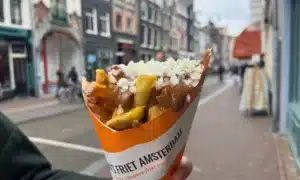
Patatje speciaal: fries with mayonnaise, curry ketchup and onions.
Frikandel speciaal: a frikandel with mayonnaise, curry ketchup and onions.
Broodje kroket: a kroket on a soft roll, usually with mustard.
Bittergarnituur: a mixed plate of fried bar snacks to share.
One tip: the “mayo” you get with your fries is often fritessaus, a slightly sweeter, lighter Dutch version of mayonnaise. Locals use it generously. Don’t be shy.
The Sweet Side
Poffertjes: Small, Simple and So Good
Poffertjes were one of my first big Dutch food surprises.
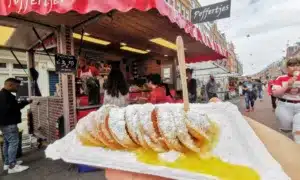
In Hamburg, we can make good pancakes too. But poffertjes are something else. These mini pancakes are puffy, light and a little bit gooey inside, served warm with a knob of butter and a generous dusting of powdered sugar.
So simple, but so good.
What I love is that they’re so small, they’re real street food. You don’t need to sit down for a whole pancake. You grab a little tray, stand at the stall and enjoy them while they’re hot.
Dutch Apple Pie: The One Closest to My Heart
If one Dutch treat holds a special place for me, it’s apple pie.
Dutch apple pie (appeltaart) is deep, generous and full of apples, cinnamon and often raisins, in a crumbly, buttery crust. You order it met slagroom: with a big spoonful of whipped cream.
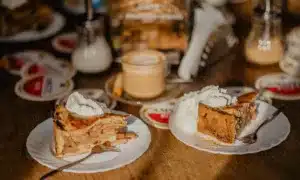
On our Humans of Amsterdam Tour, we stop at Café Papeneiland, a brown café on the corner of Prinsengracht and Brouwersgracht that dates back to 1642. Legend has it that a hidden tunnel once gave Catholics an escape route, back when their faith had to stay out of sight. Today, it serves what many locals, me included, would call one of the best apple pies in the city.
We sit together, share stories and play a fun little game. Guests share their own stories too. I’ve had countless moments of connection with our guests over a slice of this apple pie. Some of my favourite memories with my groups were made right there.
It’s not only on tours. With friends, especially on cold days, it’s always: “Let’s warm up, have a tea or a hot chocolate, and then apple pie.” I eat it in summer too, of course. But on a grey, windy afternoon, there’s nothing better.
Stroopwafels: Eat Them Fresh
You’ve probably seen packaged stroopwafels at the airport. Forget those for a moment.

A stroopwafel is two thin waffles pressed together with a layer of caramel syrup (stroop) in between. The tradition goes back to the city of Gouda, the same place as the cheese.
The best way to eat one is fresh and warm at a market, straight off the iron, when the syrup is still soft and stretchy. Locals sometimes place a packaged one on top of a hot cup of coffee or tea, so the steam softens the syrup.
Oliebollen: The Taste of Winter
From around November until New Year’s Eve, little wooden stalls pop up around the city selling oliebollen.
These are deep-fried dough balls, sometimes with raisins or apple, covered in powdered sugar. Traditionally, the Dutch eat them on New Year’s Eve, but nobody will stop you from having one earlier.
I love them. Warm oliebollen on a cold winter day, with powdered sugar all over your jacket, is pure Dutch winter happiness.
Pepernoten: Seasonal, but Not My Favourite
In the weeks before Sinterklaas on 5 December, you’ll find pepernoten and kruidnoten everywhere: small, crunchy spiced biscuits. They’re a big part of the Dutch holiday season, and many people love them.
I’ll be honest: I’m not a big fan. But if you visit in November, try a handful. You might disagree with me.
Street Food With a Story: Indonesian Satay and More
One of the biggest surprises for me in Amsterdam wasn’t Dutch at all. It was Indonesian.
Growing up in Germany, I wasn’t at all familiar with Indonesian food. The first time I tried Indonesian satay, grilled skewers with a rich peanut sauce, I thought: this is amazing. So yum.
Indonesian food has been part of Dutch life for generations, because of the colonial history between the two countries. That history is complicated, but the food has become part of everyday Amsterdam.
You’ll find satay at markets, in snack bars (often as a broodje saté) and of course in Indonesian restaurants. And the peanut sauce on your patatje oorlog? Same influence.
Surinamese food is another must. Try a broodje pom (a sandwich with a rich chicken and root-vegetable oven dish) or a roti. Together, they tell you more about modern Amsterdam than any windmill souvenir.
The Borrel: Where Dutch Snacks Shine
If you want to understand Dutch snacks, you have to understand the borrel.
A borrel is the Dutch version of after-work drinks. It starts around five o’clock, with friends or colleagues, a drink and a table full of snacks to share.
Proper borrel snacks are:
- Bitterballen, of course, with mustard
- Cheese cubes and slices of sausage, often with mustard
- Kaasstengels: crispy cheese sticks
- Seasonal snacks, depending on the time of year
Order a bittergarnituur in a café and you’ll usually get a mixed plate of fried snacks to share. It’s gezellig, it’s social and it’s one of my favourite Dutch habits.
Where to Eat Dutch Snacks in Amsterdam
My top tip: go to the markets.
Markets are where locals buy fresh produce, so the snacks are usually fresh too. Your herring, your stroopwafel, your poffertjes: it’s all really good there.
Albert Cuyp Market (De Pijp): Amsterdam’s best-known street market, with herring, fresh stroopwafels, poffertjes and plenty of international food. Open Monday to Saturday.
Lindengracht Market (Jordaan): a lively Saturday market loved by locals, with fish stalls, cheese and snacks.
Dappermarkt (Oost): a more local, multicultural market with great Surinamese and international street food.
For more ideas, read our guide to the best Amsterdam food markets.
For bitterballen and apple pie, head to a brown café. For a kroket from the wall, find a FEBO. And for herring, look for one of the many herring stalls (haringkarren) around the city.
Prefer to explore at your own pace? Our Self-Guided Food Tour de Jordaan takes you to six local stops with the stories behind them.
Exploring De Pijp? Our Self-Guided Food Tour de Pijp takes you through one of Amsterdam’s best food neighbourhoods, around Albert Cuyp Market, at your own pace.
My Honest Snack Tips
- Try herring at least once. Start with a broodje haring if you’re nervous.
- Eat bitterballen at borrel time. Brown café, around five o’clock, with a drink.
- Buy stroopwafels fresh, not just in a tin at the airport.
- Don’t queue for fries. Good fries are everywhere.
- Eat at the markets. That’s where it’s fresh.
- Go seasonal. Herring in summer, oliebollen in winter.
- Share. Dutch snacks are made for sharing, standing up or around a table.
Want to go beyond snacks? Our guide to Dutch foods you need to try in Amsterdam covers proper meals too.
Come to Amsterdam Hungry
Dutch snacks are not fancy. They’re simple, warm, sometimes a little greasy, and made for sharing with good people.
That’s exactly why I love them.
So try the herring. Burn your tongue on a bitterbal. Get powdered sugar on your jacket. And find a cosy café for a slice of apple pie with whipped cream.
Want to discover Amsterdam with a local, including a few tasty stops along the way? Start with our Hello Amsterdam Walking Tour, or have a look at all our walking tours.